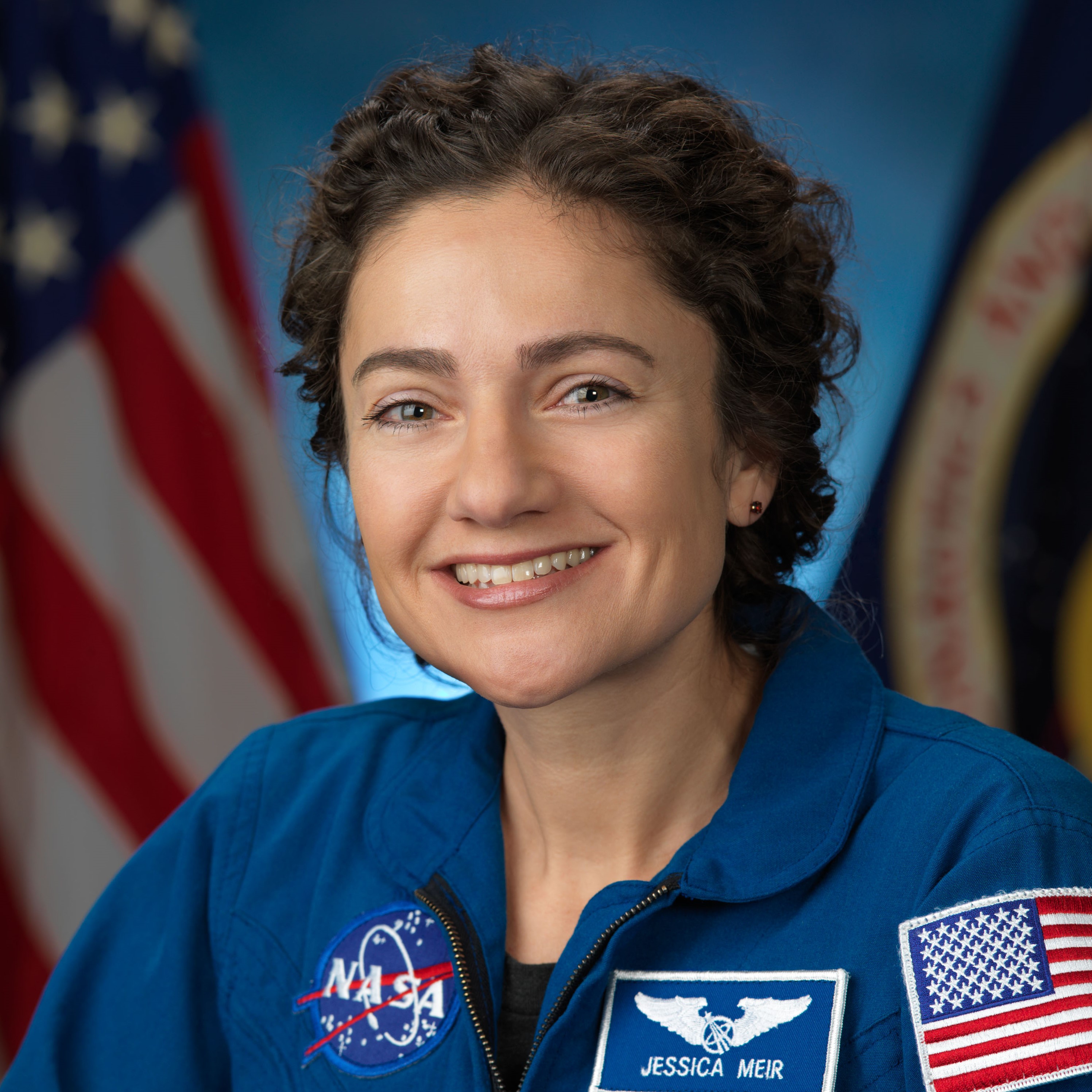










60: NASA Astronaut Jessica Meir Went Off The Earth, For The Earth
This week, Outrage! and Optimism goes galactic to talk about the relationship between policy and science.



About this episode
This week, Outrage! and Optimism goes galactic to talk about the relationship between policy and science. In a world riddled by authoritarian divisions and isolating nationalism, how do we bring ourselves and our neighbors to the realization that we are one human race on a fragile planet that we need to protect?
Upon her return back to Earth, NASA Astronaut Jessica Meir agreed to sit down with us and talk through her experience of leaving the Earth, and how communicating what is often described as “The Overview Effect” can transform how we live our lives here on our tiny, blue marble.
Our musical guest this week is Mesadorm. They recorded an intimate rendition of their song, “Easy” for us. Stick around to hear it!
—
Check out the Expedition 62 Patch designed by Jessica! So cool.
—
Mesadorm’s music video for “Easy”
This week’s musical performance was brought in partnership with Sofar Sounds. You can learn more about supporting artists around the world through live shows and performances at sofarsounds.com
Full Transcript
Transcript generated by AI. While we aim for accuracy, errors may still occur. Please refer to the episode’s audio for the definitive version
00:00:12.803 --> 00:00:14.743
Tom Rivett-Carnac: Hello and welcome to Outrage and Optimism. I'm Tom Rivett-Carnac.
00:00:16.063 --> 00:00:17.723
Christiana Figueres: And I'm Christiana Figueres.
00:00:17.723 --> 00:00:19.203
Paul Dickinson: And I'm Paul Dickinson.
00:00:19.203 --> 00:00:27.583
Tom Rivett-Carnac: This week, we discuss science as the basis of a functioning society, and we speak to astronaut Jessica Meir, and we have music from Mesadorm. Thanks for being here.
00:00:38.034 --> 00:00:39.214
Melania Guerra (guest co-host): Nice, Tom.
00:00:39.214 --> 00:00:42.254
Paul Dickinson: We'll never catch, when he's on holiday, we'll never match that.
00:00:42.254 --> 00:00:44.174
Christiana Figueres: And this is the problem, Paul. Tom is going to be away for two weeks, and I'm already getting very nervous. We're not going to be able to properly introduce this, you or me.
00:00:52.154 --> 00:00:54.334
Paul Dickinson: The passengers don't fly the aeroplane, Tom. It's that simple.
00:00:54.794 --> 00:00:56.194
Tom Rivett-Carnac: It's reading two sentences. You're going to be fine.
00:00:57.574 --> 00:01:00.274
Christiana Figueres: Okay, will you send us the two sentences?
00:01:00.274 --> 00:01:00.934
Tom Rivett-Carnac: Yeah, exactly.
00:01:00.934 --> 00:01:02.434
Paul Dickinson: Thank you. You've been doing it in your sleep all this time, and we've become mollycoddled. That's the word. And we're just not ready now to strike out on our own. I'm sorry.
00:01:09.154 --> 00:01:10.954
Christiana Figueres: How do you spell that word?
00:01:10.954 --> 00:01:12.274
Paul Dickinson: That's a nice word, right?
00:01:12.274 --> 00:01:13.754
Tom Rivett-Carnac: So I'm going on holiday next week. I'm going to be away for two weeks. What are you going to do? You're going to have guest co-hosts? You're going to figure it out.
00:01:20.754 --> 00:01:23.074
Christiana Figueres: We're going to panic is what we're going to do.
00:01:23.154 --> 00:01:24.014
Tom Rivett-Carnac: For the whole two weeks.
00:01:24.014 --> 00:01:27.474
Paul Dickinson: First, we're going to panic, then we're going to worry, then we're going to start blaming other people. That's my plan.
00:01:31.694 --> 00:01:32.434
Tom Rivett-Carnac: How's everyone doing? Christiana, are you back at the beach or are you still in San Jose?
00:01:35.094 --> 00:01:36.894
Christiana Figueres: No, no, I'm in San Jose. I've been here for a few days and I will be here till the end of the week.
00:01:40.274 --> 00:01:41.254
Tom Rivett-Carnac: Very nice.
00:01:41.254 --> 00:01:42.214
Paul Dickinson: Yeah. Mr. Paul? I am here on the south coast of Brighton. No, south coast of England in Brighton. That's the one. Yep, that's it. And it's kind of, you know, it's a typical gray, wet, not very warm July.
00:01:55.634 --> 00:01:56.894
Tom Rivett-Carnac: I know, I know. As a result of that, we are going south. So we didn't know what we're going to do for summer, but we're going to go to Switzerland. So we're going to stay in a very nice place there. We're driving on Sunday. Apparently it's fine. We're going to go on the boat from Calais to Dover and be away with the family for two weeks.
00:02:08.774 --> 00:02:09.374
Christiana Figueres: Nice. How long does it take you to get there?
00:02:11.054 --> 00:02:16.134
Tom Rivett-Carnac: Six hours, six hours with two children in the back of the car saying, are we there yet? Can I have your phone? Are we there yet? Can I have your phone? Are we there yet? Can I have your phone? So I'm looking forward to it.
00:02:20.094 --> 00:02:21.594
Paul Dickinson: Are they tame children?
00:02:21.594 --> 00:02:22.534
Tom Rivett-Carnac: Paul, you know my children.
00:02:22.534 --> 00:02:22.634
Clay (podcast producer, live in studio): No.
00:02:25.914 --> 00:02:30.574
Paul Dickinson: I'm introducing these feral kings and queens to the listeners. How would you describe them?
00:02:32.354 --> 00:02:36.014
Tom Rivett-Carnac: They certainly have their own opinion about things.
00:02:36.014 --> 00:02:39.234
Christiana Figueres: Which they express in very uncertain terms.
00:02:40.894 --> 00:02:43.874
Tom Rivett-Carnac: Zoe used to go and do cooking with Christiana at her flat in London. And some things were still standing after a couple of hours, I seem to remember.
00:02:47.894 --> 00:02:48.994
Christiana Figueres: Yeah, the plastic bottles.
00:02:51.774 --> 00:02:53.194
Paul Dickinson: Very brave, very brave. Hey listen, I want to share something with you from last week. Do you remember our wonderful Beans on Toast who was speaking? He said something, a musician, J, that's right, J. I was using his stage name. Oh sorry. And we were talking about artists and what they should do. And he said, I don't think anyone's ever really known what an artist's kind of duty is in humanity. And that is kind of the beauty of it really. And I thought that was a fascinating insight into the role of the artist. And we had a conversation about Jane Fonda saying famous people should be repeaters. But then Jane talked about the K-pop fans. And I got all excited and started laughing. And I just wanted to share with any of our listeners if they don't know about this. But you may have come across the fact that Donald Trump, poor Donald Trump went to a rally that was not half as well attended as he thought. And the Financial Times reported on the 21st of June that it appears at least some of the million sign ups that didn't turn up were prompted by a call to action from TikTok user Mary Jo Laupe, who is a 51 year old posting under the hashtag TikTok grandma. And on June the 11th, she urged her followers in a clip that was viewed more than 2 million times to apply for two free tickets to the event. So there you go.
00:04:07.974 --> 00:04:10.034
Tom Rivett-Carnac: Grandma, I love it.
00:04:12.394 --> 00:04:19.574
Christiana Figueres: I gather that this is now a little tactic that is being used for several of his gatherings. And he is quite upset about it. I'm not sure how they're going to correct that. Correct in quotation marks.
00:04:27.294 --> 00:04:28.234
Paul Dickinson: Indeed.
00:04:28.234 --> 00:04:29.254
Tom Rivett-Carnac: It's getting alarming. Well, it's not getting alarming. I mean, obviously at the moment, it looks pretty good in terms of the US election, but touch wood when we say that, who knows, right? It's a long way to go. I have found, can I use this moment just to make a very quick political announcement, which is that I've found a way to be helpful in the US election. I have a good friend who we also, you also know Christiana, called Yassamin Ansari. She is an Iranian-American woman, still in her 20s. She's running for Phoenix City Council. And it's kind of an important position to help run the city and lead on climate change. She's a brilliant candidate. She has to win. Tomorrow, when this podcast comes out on Saturday, I am doing a fundraiser together with our good friend Ben Rhodes, former Deputy National Security Advisor for President Obama. He and I were doing a fundraiser. If you want to join that, if you're a US citizen, you want to donate to Yassamin's campaign, Yassamin Ansari, just Google her, you'll find it. Join us and join us in conversation together with Ben on Saturday.
00:05:19.734 --> 00:05:20.254
Paul Dickinson: Great.
00:05:20.254 --> 00:05:21.734
Christiana Figueres: That is really excellent. And Yassamin really would be such a breath of fresh air. But Tom, what about those of us who are not US citizens? Is there any way for us to help?
00:05:28.954 --> 00:05:31.094
Tom Rivett-Carnac: No, because of course you can't give to... You can be helpful on Twitter and promote it and that sort of thing. But that's why I was so pleased to find a way to be helpful.
00:05:36.734 --> 00:05:38.874
Christiana Figueres: Or we can find US friends who would donate.
00:05:38.874 --> 00:05:39.374
Tom Rivett-Carnac: Exactly. And God bless Ben Rhodes. So nice of him to participate with us and help her in that way.
00:05:44.534 --> 00:05:45.394
Christiana Figueres: Absolutely. And God bless you, Tom, for hosting.
00:05:47.394 --> 00:05:48.474
Paul Dickinson: And God bless you.
00:05:48.474 --> 00:05:51.314
Tom Rivett-Carnac: And God bless Paul, just in general.
00:05:51.314 --> 00:05:52.254
Paul Dickinson: All the time. But let's particularly God bless Clay for putting the link to that fundraiser in the show notes.
00:05:56.874 --> 00:05:57.354
Clay (podcast producer, live in studio): It'll be there.
00:05:57.794 --> 00:05:58.614
Tom Rivett-Carnac: Absolutely, yeah. And God bless Christiana. Yeah. Right. To business. So this week, we are going to talk about the very intricate and important relationship between science and policy making. We know that we cannot have a functioning society unless we have a platform on which we can agree on basic facts. And that has really been under threat in all sorts of ways in recent years. But what we found through the coronavirus is that people have begun to understand the importance of science again. They've begun to understand the importance of listening to science and translating that into policy. So is this a moment for optimism, for hope that actually we're going to find our way back to understanding and realizing that our society has to be based on good science, and that will enable us to move forward and address threats together? Discuss.
00:06:44.674 --> 00:06:45.814
Christiana Figueres: Well, discuss. Well, thank you for that instruction.
00:06:49.474 --> 00:06:50.174
Paul Dickinson: No, we won't.
00:06:50.174 --> 00:06:50.914
Tom Rivett-Carnac: We won't discuss it. There you are.
00:06:52.034 --> 00:06:53.314
Paul Dickinson: Different topic.
00:06:54.834 --> 00:06:58.174
Christiana Figueres: Well, what an important topic, honestly. And it is one of the highest hopes that are coming out of this COVID crisis, isn't it? The fact that at least in those countries that have paid attention to science, they seem to be doing better. I will spare you of an update on Costa Rica. But it does seem that there is one light motif coming, and there are many light motifs coming out of the COVID crisis lesson treasure box. But one is science is back. Those health professionals are definitely playing an incredibly critical role. The science that they are executing, implementing the science that they are using to suggest policy that makes sense is definitely what is making a difference in some countries. And those countries that are not doing well are precisely because they are not heeding the science. So is this, and we've discussed this ad nauseum, I think, on this podcast, is COVID going to change many of our mindsets, many of the ways that we do things, including paying attention to science, whether it be for health, human health, or whether it be for global planetary health, i.e. climate change. So yes, one of the big chunks that we hope are going to be lessons learned and sticky lessons that will stay with us after we get over the COVID crisis itself.
00:08:39.874 --> 00:08:40.994
Tom Rivett-Carnac: Paul?
00:08:40.994 --> 00:08:48.174
Paul Dickinson: There is a risk that listeners will find large sections of the financial time simply channeled through me into your ears. But I read a fascinating article suggesting that COVID will kind of kill populism to a degree for exactly the reasons Christiana just mentioned. That is that we've gone from sort of stumbling through our kind of guts and our feelings and some pretty obscure rhetoric into a land of consequences where we listen very, very carefully to scientists. And that was on the sales of Greta's boat as you cross the Atlantic, Unite Behind the Signs. So we're doing that. And just one beautiful example of that from a real proper grown up, I think. Just today, 8th of July, when we're recording this, Christine Lagarde, president of the European Central Bank, has opened the door to using a 2.8 trillion euro asset purchase scheme to pursue green objectives. And in fact, she says that acting on climate change, there's nothing that she believes in more strongly. And she believes the European Central Bank has to look at all the business lines and operations in which they are engaged in order to tackle climate change, because at the end of the day, money talks. And so I just want to draw great joy and satisfaction from that kind of inspired leadership. And to wonder, you know, really, when are the political community going to catch up? It's now time, you know, these are elections now are about matching these these moves from scientists and from administrators and regulators all around our society.
00:10:17.654 --> 00:10:18.774
Tom Rivett-Carnac: Yeah, no, I think that's great. I mean, she's been such a good leader in so many ways, and it's really inspiring what she's done there. But just to talk about that kind of intersection of it. One thing that this reminds me of what you just said, Christiana, is, you know, when we had Juval Harari on, he said that the mistake we've made is we've allowed the means by which we achieve our aims to set our goals, right? That the sort of the process of economics sets the objectives of economics. And of course, we get very lost by doing that. Whereas the place that we can actually set our goals and we can set our north star and we can have an agreed reality is through science. And one of the things I've found myself reflecting on is I've watched like these Boris Johnson briefings and others is how differently experts talk compared to politicians. You know, politicians are like, oh, it's all going to be fine. And here's the reason. And here's why I'm great. Whereas experts are like, we don't really know that. And we're going to do our best to figure it out. And here's what we do know. And here's what we don't. And our knowledge is always changing.
00:11:11.294 --> 00:11:12.114
Christiana Figueres: And here's the warning.
00:11:12.114 --> 00:11:13.054
Tom Rivett-Carnac: And here's the warning. And it just sort of made me reflect on the fact, you know, Yuval's Harari's point that we made this systemic mistake, the reemergence of science in the face of this, of how different our society would be. If we could really make that change, we could really understand that it's not about bluster. It's about reality, identifying it, uniting behind it and taking meaningful and rational action in response to it. It's very tantalizing in a way.
00:11:33.054 --> 00:11:39.654
Christiana Figueres: I mean, the question is, you know, how many times do we have to be clobbered over the head to learn that lesson? So today we're going to be interviewing a fantastic female astronaut that we will introduce in a minute. But in preparation for this conversation today, friends, my daughter, Jihanna, sent me a quick little article about what happened way back in 1986 when the Space Shuttle Challenger was sent out or tried to be sent out. And I'm sure all the listeners will remember because either they witnessed it or they have heard of it for the younger ones, that the Space Shuttle Challenger left its station and 73 seconds into its flight, it burst into flames and all seven crew members were burned to death. Now what is incredible about that is that the investigation that then ensued about what had gone wrong showed that Roger Bourgeolet was a very high-ranking engineer and that he had warned repeatedly that if there was cold weather, the seals of the huge rocket boosters would fail. And he said, and I quote, the result could be a catastrophe of the highest order, i.e. loss of human life. End of quote. Now the night before the lift-off, the temperature in Florida did actually dip below freezing, which is highly unusual for Florida. And he begged, begged his bosses and the NASA authorities to delay the launching of the Challenger. He was overridden because of policy, because of politics, because there was such public expectation that the Challenger would take off on that day. And they were willing to be completely blind to his warnings that came out of his scientific observations of the reactions of these boosters to different temperature. So, we lost 7 astronauts, and, of course, a huge hit for NASA's credibility for what they did later. Now, Mr. Bourgeolet was then ostracized. No one in NASA wanted to have anything to do with him. He was ostracized from his own company that was a company that was producing these boosters for NASA. And for a long time, despite the fact that he took all the evidence to Capitol Hill and showed them the memos and what he had warned, etc. He was really ostracized as a whistleblower until finally everything was on the table and he was then redeemed and awarded the prize for scientific freedom and responsibility by the American Association for the Advancement of Science. So, what a story of the confrontation here between science and politics or policy, whichever way you want to look at it, with the attendant human loss and the incredible, obviously the financial hit to NASA and the credibility hit, et cetera, et cetera. Huge ramifications. And, you know, just because Jessica, that we're going to interview, is a female astronaut. I was also really tickled to read in this article that he said that the only person who supported him after his first appearance before the Commission on Capitol Hill was Sally Ride, the first American woman in space. He said she was the only one, the only one, who came up and gave him a big hug and thanked him for his bravery. So there you go. What a story. But, you know, what concerns me is, I don't know how many of these stories we've had, and do we learn from them?
00:15:48.454 --> 00:15:50.814
Tom Rivett-Carnac: I mean, it's an amazing story, and it illustrates what's great. It illustrates on a human level some of these systemic pressures that we go through between, you know, a sort of leadership bravado to kind of move fast and break things that has some assets. I mean, obviously, it was a disastrous in that case, but there can be a leadership element of wanting to like be entrepreneurial and be creative, and the necessity to have science play its rightful role to kind of fit within that. And the tension there that has historically always been there. But I think what you're pointing to, and kind of what we're pointing out here, is that we've got that balance wrong, right? It's always going to be a tension. We're never going to resolve that. It's never going to be a simplicity saying, now we're science-led, we don't do these other things. But we need to rebalance that, particularly when it comes to major long-term systemic scientific threats, like the climate crisis and like the pandemic. And that's where we kind of have an institutional weakness, right? Because that's, you know, it's human nature to kind of have a go and try and figure stuff out as you go. What do you think, Paul?
00:16:45.414 --> 00:16:48.514
Paul Dickinson: I was about to say, I'm not entirely sure we do have an institutional weakness. I believe we have a little institutional jewel in the great pile of rubbish that is a lot of contemporary society. And that is the actuarial profession. Now, I myself have gone and hung out with actuaries since about 2002. And I find them more fascinating than they find themselves, to be honest with you. But the thing about that...
00:17:10.414 --> 00:17:12.214
Christiana Figueres: That's not difficult.
00:17:12.274 --> 00:17:14.254
Paul Dickinson: Don't, please, Christiana, I have the greatest respect for you. But I would like you not to say anything against actuaries, if you didn't mind.
00:17:17.534 --> 00:17:19.414
Christiana Figueres: I stand corrected.
00:17:19.414 --> 00:17:20.534
Paul Dickinson: Here's the thing. I was talking to an actuary who was working at a very large reinsurance company about climate change risk. And he kind of looked at me. And he kind of, he was kind of just like, he was quite emphatic, should we say. And he said, you know, people are like not taking much action on climate change because they're not certain what the impacts will be. He said, I'm an insurer. He said, I'm a long tail insurer. He says, I insure these kinds of risks with like medical drugs and things like that. And he said, when you've got uncertainty, he said, the premium is completely sky high, it's through the roof. You never charge more than when you have an uncertain risk. And what he was trying to say in very simple language was, the reason we should absolutely, you know, divert all our energies and all of these trillions of restructuring to do something about climate change is not because we know what the impacts will be, but because we actually don't. Yeah.
00:18:13.574 --> 00:18:24.134
Christiana Figueres: Well, I think we talked about this, if I remember correctly, on one of our podcasts about climate being a high probability and high impact, high negative impact risk. So it stands in that quadrant, right? It's not low probability, high risk.
00:18:28.294 --> 00:18:30.534
Paul Dickinson: It's not a very nice quadrant to be in.
00:18:30.534 --> 00:18:34.614
Christiana Figueres: No, it's the absolutely most critical quadrant.
00:18:35.734 --> 00:18:46.094
Tom Rivett-Carnac: Paul, if I go to the Association of Actuaries and they don't have on their home page by tomorrow, actuaries are the jewel in the rubbish heap of institutions, as a quote from Paul Dickinson, I'm going to be very disappointed.
00:18:47.354 --> 00:18:59.334
Paul Dickinson: I know someone on this podcast has won the Legion d'honneur and various other prizes, too numerous to mention, but I'm going to mention that I got a silver pin from the UK actuarial profession for my volunteering. Thank you.
00:19:00.354 --> 00:19:01.874
Christiana Figueres: Thank you for sharing.
00:19:02.254 --> 00:19:03.694
Tom Rivett-Carnac: Were you making the tea or what were you doing?
00:19:05.334 --> 00:19:06.414
Christiana Figueres: No, Tom. Tom.
00:19:07.134 --> 00:19:08.394
Tom Rivett-Carnac: Thank you, Christiana.
00:19:08.394 --> 00:19:09.734
Paul Dickinson: Please.
00:19:09.734 --> 00:19:10.754
Tom Rivett-Carnac: Right. So we're bringing you an amazing interview today. As Christiana said, we have long wanted to interview this person, and actually it's perfect timing. In part because if you think back, friends, the last week when we interviewed Richard Curtis, we had some questions from the audience, and they were very good questions. But what was really interesting about them was even though we were talking about pensions and the chance to change the future through the pensions, the questions were all about this persistent issue we've talked about on the podcast around, what does it mean to live at the moment, witnessing this kind of unraveling of our world, how painful that can be, how numb people can feel. And so I think what's really nice about this conversation is it is based in science. She's an amazing scientist, but it's also about perspective and what perspective going to space and looking back at our earth can give you. So I think this will be a really nice.
00:19:58.114 --> 00:20:01.594
Christiana Figueres: And how she wants all of us to share in that perspective.
00:20:01.614 --> 00:20:02.974
Tom Rivett-Carnac: Yeah, absolutely. So Jessica Meir is an American-born NASA astronaut. She's had the most amazing life in Korea. She's also a marine biologist and a physiologist. She studied first the diving physiology and behavior of emperor penguins in Antarctica and the physiology of geese in their migration over the Himalayas. Then in 2002, she became an aquanaut at NASA in the NASA Extreme Environment Mission. And then in 2013, she was selected by NASA into an astronaut group. She launched into space on the 25th of September last year, went to the International Space Station that you'll hear her talk about. She served as a flight engineer and on the 18th of October, together with Christina Koch, were the first women to participate in the all-female spacewalk. And she came back to Earth on the 17th of April, where she landed in Kazakhstan. She's the most amazingly thoughtful, eloquent person. We were very privileged to have her on.
00:20:59.114 --> 00:21:01.374
Paul Dickinson: I mean, she's basically a superhero, isn't she? Or a heroine. I mean, I don't know. You know, I've just all of these things.
00:21:03.654 --> 00:21:05.014
Tom Rivett-Carnac: I've never heard anything like it. I mean, you know what I discovered in the course of doing this research? She's younger than me. It's always frightening when you discover that these brilliant people are younger than you.
00:21:13.214 --> 00:21:18.874
Paul Dickinson: Yeah, no, it was always tough when the president of France is younger than your nephew or something.
00:21:20.194 --> 00:21:35.774
Christiana Figueres: And given the fact that it was Melania Guerra, who has been on this podcast and who introduced us to Jessica, we've actually invited Melania to be a surprise co-host with us today on the podcast.
00:21:35.774 --> 00:21:36.254
Tom Rivett-Carnac: Let's listen.
00:21:42.225 --> 00:21:49.045
Christiana Figueres: Well, Jessica, thank you so much for joining us on Outrage and Optimism. We have been on your tail for quite a while, in fact, even when you were out in space, and through our friendship with Melania Guerra, who you studied with at Scripps Institution of Oceanography. So we thought, since this has finally come about, which we are totally celebrating, we thought we would, as a huge exception to our rule, where we usually co-host, the three of us, we would invite a fourth co-host, and we have Melania Guerra, who will also be on the tape with you today. And it is Melania's birthday. So this is our form of saying, Happy birthday, Melania. Happy birthday. So Paul and Tom and I will be in conversation with you, but you better get ready, because Melania will have the last question. So we thought we would love to start off our conversation today, a little bit on the personal side, because it's not everyone who gets to be an astronaut. It's not everyone who gets to realize their childhood dream. You, by self-admission, drew a picture of yourself in a spacesuit for a school assignment at the age of seven. So how does Jessica go from a little drawing on a piece of paper to actually stepping into a spacesuit and doing what NASA has trained her to do? It is a long journey, a long life journey. How did that happen?
00:23:26.005 --> 00:23:30.025
Jessica Meir (guest, NASA astronaut): Well, first of all, it is lovely to be here speaking with all of you today. I am very impressed by this podcast, and it is certainly a very important topic to me. And I am glad that you brought in the Melania Factor because she is of course a very special friend. And I am very, very happy to be doing this on her birthday as sort of a birthday present for her as well. So thank you for mentioning all of that. So it is true, I did, my first memory of wanting to be an astronaut was this mental image I have of when I was in the first grade, and our teacher asked us to draw a picture of what we wanted to be when we grew up. And I drew a picture of an astronaut in a spacesuit standing on the surface of the moon, sort of that iconic image next to the American flag. And it was just something that I always said ever since then. My mom says I actually even started saying it as early as five years old. And it was always what everybody associated with me. Everyone called me things like space girl and expected me to always be involved in all of these space related activities as much as possible. And so that's exactly what I did. I went through my life trying to involve myself in any opportunity where I saw an opening for something that was space related or some kind of training session with NASA. And at the same time, I was pursuing biology as my favorite subject. So as a kid, I think I was just inspired by the natural world around me and the diversity in the plant and the animal kingdom. And perhaps also just spurred on by the fact that my mother was a Swede and who many Swedes of course inherently connected to nature. And she spent a lot of time with us outside. So some kind of, I think, combination of these things gave me this passion for exploration and for nature. And I think that the cosmos and NASA and a career as an astronaut were sort of just a natural extension for that. But I did try to really follow both of those goals in parallel. Studying biology as an undergraduate and going on to graduate school after working at NASA for a few years. So kind of jumping back and forth between the two and trying to find a way to combine those pursuits. And I think if you really boil it down to one common element, it's this extreme environment and looking at the physiology of animals in extreme environments. That's what really drove me as a scientist and brought me to incredible places like the Antarctic.
00:25:57.745 --> 00:26:00.185
Christiana Figueres: Like Antarctica, exactly.
00:26:00.185 --> 00:26:01.245
Jessica Meir (guest, NASA astronaut): That's right. So to study animals that were really working and living and exhibiting these remarkable behaviors at the extremes, like for example, an emperor penguin that can dive on a single breath for over 30 minutes. So understanding and trying to unravel some of these secrets and what is unique and special about these animals to allow them to do that. And now at the other end of the extreme, I guess I am the animal in the extreme environment, living in space, which is perhaps the harshest and most extreme.
00:26:36.045 --> 00:26:38.605
Christiana Figueres: That's a nice way to put it.
00:26:38.605 --> 00:26:48.985
Jessica Meir (guest, NASA astronaut): Well, I do sort of look at it as coming full circle where I used to do experiments on these remarkable animals to understand more about what makes them unique. Now I'm the one being experimented upon in the extreme environment. And the extreme environment is that, of course, of space. So I went from working at NASA and coordinating life science experiments to going to graduate school and then having a career as a scientist studying the animals in extreme environments. And now finally, to being the animal in the extreme environment that's being experimented upon. So I guess it's just my turn.
00:27:16.985 --> 00:27:21.445
Christiana Figueres: Are you being experimented upon by yourself or by others? And what are the lessons from that experiment?
00:27:25.525 --> 00:27:39.945
Jessica Meir (guest, NASA astronaut): Well, as astronauts, we are human subjects for a variety of different physiological and medical experiments on board the International Space Station and other platforms that we have flown on in the past, like the space shuttle. So I think it's a very important part of our jobs where we do need to make sure that we are signing up for these experiments and participating in them because we need to know more about how space flight and the microgravity environment affect us as humans. First of all, to make sure that we can bring astronauts home safely from their missions, but also to make sure that we can deliver astronauts safely to their destinations. For example, when we eventually go to Mars, that will be something like a three year mission. And being in microgravity and space flight environment for an extended period of time, of course, has a lot of deleterious effects to our bodies with the offloading of gravity. We have a loss of bone density. We have muscle atrophy, our muscles wasting away. We are subjected to some higher levels of radiation than we are here on Earth. So all of these questions, all these things need to be solved in order to understand more about humans in order to keep us safe as astronauts. But also, it's also very important to bringing this back to the Earth itself. A lot of these questions actually have parallels to disease states on Earth. So the things that we are learning by being experimented upon and other experiments that we're doing on the space station as well, are really, as we say at NASA, off the Earth for the Earth. And we are bringing these results directly back to people on the ground. There are many real life applications in terms of pharmaceutical research and drug development and other parallels that have direct correlations to situations, disease states or other Earth technologies with things that we can learn and with the results that we are gaining from these experiments in space.
00:29:27.765 --> 00:29:31.045
Christiana Figueres: Off the Earth for the Earth. That's a beautiful concept. Beautiful concept. Because it takes us sort of away in order to come back to ourselves, doesn't it?
00:29:40.905 --> 00:29:42.225
Jessica Meir (guest, NASA astronaut): Yeah, it certainly does. And I think it's, I've heard an astronaut say before, everybody returns, every astronaut returns to Earth, an environmentalist or an eco-warrior, or I forget the exact words that he used. But I think it is true. It is difficult as a human to go into space and to look back at our planet and to see it from above, truly from the outside and to not have it change you. And that's something, you know, Frank White even wrote about it and called it the Overview Effect, in terms of how it changes you as a person to experience that, to look back at the Earth and what it does to you philosophically, and how it changes the way you think about not only yourself, but your position in the grander scheme of things on the planet, in the solar system, and in the universe. And one of the most resounding parts of that, or components of that, for me and I think for most people, is how that makes you view our planet. When you look back and you see this brilliant blue marble that is truly this beacon below you in the blackness and the void of space all around, and the vibrant color palette, and the very, very thin, tenuous band of an atmosphere, it makes you realize, wow, this is not only beautiful and special, but it's very fragile, and it is something that we need to take care of. We need to protect it. And for me, that was something that I'd always thought a lot about. I've considered myself an environmentalist long before I went to space, but I can say that having seen it with my own eyes, because it resonates even more loudly now, having even more of an appreciation and more of a desire to protect it and to make sure that we are all doing whatever it is we can to help move in that direction and preserve this planet, this unique home that all 7.5 billion people call home, to preserve that for the generations to come. And I've heard so many astronauts come back and say that, even people who didn't actually think about climate change or these environmental issues very much in their lives before going to space. So it's a very unique vantage point that we are incredibly privileged to have.
Load More00:32:05.865 --> 00:32:08.165
Tom Rivett-Carnac: It's so beautiful to hear you talk about that. And of course, the overview effect is so famous. I think it was Michael Collins who said, he got out there and looked back and just felt it's tiny, it's beautiful, it's home and it's fragile. And hearing you speak then, I mean, you've clearly been aware of these issues of the environment for a long time, but still you went out to space, you look back and it still had that kind of deep effect on you. And I've, I've seen some, some analysis that suggests that astronauts that return not only have that kind of cognitive shift, but they tend to change their lives as well afterwards and live in a slightly different way. So I'm curious to know those sorts of changes that the overview effect describes are sort of what we collectively as humanity need to sort of step into and embrace a bit more. Having come back and having had that experience, did you get any insight into how, you know, not everybody can go into space, but how we can all get more of a flavor of that so we can all have that sense of fragility and responsibility and beauty of the planet?
00:33:07.845 --> 00:33:11.925
Jessica Meir (guest, NASA astronaut): Yeah, that's an excellent question and I wish I had a great answer to that one. It is something I thought about a lot and still think about so often, especially right now with so much going on in the world, ranging from environmentalism and taking care of our planet, to this global pandemic, to the civil unrest that we are experiencing in our country right now. And for me, all of those things are the one, the one underlying theme that also resonated so loudly from looking at the planet from space, is that we are truly all in this together. And for some reason, when you experience that, just like the Overview Effect describes, when you see this with your own eyes, and you see the land masses that are all connected, and the oceans, and how everything is spinning really down there beneath you, in its entirety, it really is one object and one home. And that's so plain to see from your eyes and from your perspective up there. And I wish that I could transport every human's eyes up there with me to gain that kind of appreciation, because it's really clear from there. It is absolutely clear. And I think that most people would agree with me when they feel the same way when they're looking at it. So one of the things that we try to do as astronauts is to serve as ambassadors to help spread that knowledge, just as many of you do in the climate world, to first of all inform people, to make sure that people are aware of all these things. That's really number one, is to make sure that we are educating. Because although all of these issues may be painfully clear to you and to me, the word still needs to get out there in certain communities. We need to make sure that we are doing our best in communicating, as well as just gathering the science and trying to inform policy. Because if you can't educate the public and the constituents and all of the people, the general public on the planet, then I think that we are in a bit of a losing scenario. So I think that's incredibly important. So we try to serve as ambassadors in sharing our views, our experiences, our photographs. I tried to share a lot of what I called earth art type photos. I'm certainly not the first astronaut to do that, but to try to help relay the beauty of the planet, different ways that we can think about it and make those connections. It's something I've said as well. I wish all of the world leaders could be up here and see this view because I think it really could be paradigm shifting in terms of how it does change you as an individual. So short of getting everybody to space, I think we can just try to use all of these means of photo and video. There's a new project that's being done on the space station right now called the ISS Experience and it's actually a 3D virtual reality, 360-degree virtual reality, completely immersive experience. And that is something that I am blown away by how it enables me to share what I do with people because you really feel like you're there and experiencing it. And so we have footage now of that camera inside the cupola looking down at the planet and maybe those kind of views will help people relate to that feeling and that perspective a little bit better in the future. So I think just continuing to communicate is the thing that I'm trying to do the most. But I would love it if you have any more ideas on how to help share this perspective.
00:36:45.225 --> 00:36:49.105
Christiana Figueres: Well, Paul wants to jump in, but I'm sorry, Paul, can I just go for it?
00:36:49.105 --> 00:36:49.405
Paul Dickinson: Go for it.
00:36:49.425 --> 00:36:53.745
Christiana Figueres: Jumping at the bit here to ask us a follow up to that. Jessica, in this very intentional communication effort that you're now on, are you trying to reach people's head or people's heart?
00:37:04.465 --> 00:37:11.565
Jessica Meir (guest, NASA astronaut): I think I try to reach both people's heads and their hearts, because I think that both are equally important. And it goes back to bits of advice. And one of the typical questions we always get asked as astronauts, do you have any advice for kids or for people aspiring to be astronauts? And the thing that I always come back to is to that passion and making sure that you are following what it is that you're passionate about. And so I think that that's incredibly important in communicating all of these ideals and communicating what is important, the issues and the data that we have now about our changing climate and the effects it's going to have and what we need to do to inform these decisions. People need to care, first of all, before they can use their brains. We definitely need the heads as well. We need their brains to make those changes. They have to be intentional. People have to be do these things very consciously. But I think if we don't first capture their hearts, then you just won't have the same kind of support and out.
00:38:11.145 --> 00:38:13.965
Christiana Figueres: Paul, sorry, I bow to you now.
00:38:13.965 --> 00:38:24.945
Paul Dickinson: So look, Jessica, I just want to lower the tone a little bit here to try and bring us down, to allow people to kind of connect with your extraordinary experience of more than 200 days in space. So forgive me asking a silly little question, but what was the best moment and what was the worst moment?
00:38:30.765 --> 00:38:35.625
Jessica Meir (guest, NASA astronaut): That's difficult to put into words of what the best moment was, because there were very, very many. But I think that one of the best, of course, that I can think of right off the top of my head is the moment that I arrived on the International Space Station. And for people like Melania that know me well, I think the look on my face really captured exactly my sentiments and everything that I was feeling. And it was interesting. There was a certain combination of words that so many people contacted me with and used to describe what they saw when I arrived on the space station. And so many different people, from all different walks of life, everybody used the combination of words to say, pure joy. There was just this look of pure joy on your face.
00:39:17.065 --> 00:39:18.985
Christiana Figueres: Oh, how beautiful.
00:39:18.985 --> 00:39:26.985
Jessica Meir (guest, NASA astronaut): And I thought it was a really interesting choice of words because I don't think it's, I don't think joy is actually a word that people use very commonly. You know, we say-
00:39:27.925 --> 00:39:30.565
Christiana Figueres: Let's put it this way, not in the science field.
00:39:30.565 --> 00:39:32.105
Paul Dickinson: Not enough, not enough. That's what I'd say.
00:39:32.765 --> 00:39:33.785
Christiana Figueres: Not enough.
00:39:33.785 --> 00:39:49.745
Jessica Meir (guest, NASA astronaut): But even when they're talking about that emotion, I think people use the word happy or they, there are other words that we, we've used and everybody from very, very different backgrounds, sets of people were saying the same thing, saying pure joy. And that moment, it just, it was, it was surreal opening that hatch and being on the space station. I mean, really all of it was surreal. It's something that I say a lot and I think maybe that's just the way my brain kind of works. And when these things, when these extreme things are happening to me, that I, that it's difficult for me to believe that they're actually real. And I think for that, for this, this was something I thought about since I was five years old and worked so hard at trying to achieve my entire life. So I think that joy when I first got to the space station, and not only did I arrive to the space station, I also arrived to an assortment of crew members, many of which were actually, many of whom were actually my classmates. So when I say my classmates, these are the other individuals that were selected to be astronauts at the same time as me, and they're like my brothers and sisters.
00:40:42.905 --> 00:40:48.165
Paul Dickinson: So it's a kind of class reunion as you're spinning around the world at 17,000 miles an hour, right?
00:40:48.165 --> 00:40:48.805
Jessica Meir (guest, NASA astronaut): It was. At that moment, there were actually four of the eight of us. So 50% of our class was up there at the same time, which was something I never dreamed could happen. And so I think that was probably one of the best moments. The worst moments, I don't know if I had a worst moment. I was really smiling for almost seven months straight, which again, I think Melania can attest to, is not my normal state.
00:41:14.305 --> 00:41:16.785
Paul Dickinson: Not anybody's normal state, really.
00:41:16.785 --> 00:41:17.585
Jessica Meir (guest, NASA astronaut): Right. But of course, you know, there are moments that are frustrating when you're working on something and maybe it's not going as planned. And, and as astronauts, of course, you can imagine a lot of us are perfectionists. And we feel an incredible sense of responsibility when we're up there because we know how fortunate we are to be the ones on that end. And there are so many other people that are equally deserving of that opportunity, but unfortunately, only a few of us get it. So it's really an enormous sense of responsibility that when you put this pressure on yourself. And I think for me, those were some of the harder moments for me, was actually just realizing that I couldn't physically do everything that I wanted to do for everybody else and for myself while I was up there, just because I was limited by time. So that was something that I had to deal with.
00:42:11.265 --> 00:42:15.345
Christiana Figueres: What was one thing that you really wanted to do that you didn't get to?
00:42:16.385 --> 00:42:22.485
Jessica Meir (guest, NASA astronaut): One thing that I really wanted to do that I didn't have a lot of time for was I flew a piccolo up there. I play the flute and piccolo and saxophone. And I decided not to fly the flute because it was taking up too much space in my very small allocation. So I flew the piccolo. And then there was also a saxophone on board that Thomas Pesquet, the French astronaut, had left up there. And I had grand plans to really spend some time playing these instruments. Actually, playing music has been one of the things that I found that I really miss about my life in terms of getting older and not having time to do all of these things that we used to do when we were younger. And so I really was hoping to have some time to connect with my musical instruments up there. And I played them a couple of times and over some short periods, but not in the way that I'd intended. Wow.
00:43:07.805 --> 00:43:13.585
Tom Rivett-Carnac: I didn't think the answer to that question was going to be, I didn't get enough time to play music, but that's amazing that that's the answer. Can I ask sort of, you've answered part of this question already, but I'd be really interested to hear your sort of straight answer to it. What can leaving the planet do for our attempt to live well on it?
00:43:26.525 --> 00:43:33.485
Jessica Meir (guest, NASA astronaut): I think that leaving the planet can do a lot of things in terms of what we can bring back to our own planet. And the first of all, that is science and data. And I think we all understand that those are really the foundations of what we need to provide to the world in order to make these well-informed policy decisions, so that we can take the steps necessary to save our planet. So at NASA, we have a lot of different experiments and a lot of ongoing areas of research that do bring back that earth science aspect to deliver what we're saying, this off the planet for the planet, off the earth for the earth. And I think that's an incredibly important part about what we do at NASA. And a lot of times, people forget about those experiments because they're not as visible. They don't have a human element in them. People love to tell the stories and take pictures and video and see us doing an experiment, one that requires human interaction. Whereas a lot of these experiments actually don't. They are a piece of hardware or a scientific instrument that may be mounted on the outside of the internal space station, for example. Of course, there are many other remote sensing and satellite systems that NASA has out there for a variety of scientific experiments that are not on the International Space Station. But I'm a little bit more familiar with those that are, given the fact that I spent almost seven months there. But these instruments, a lot of them are mounted on the outside of the space station, so they receive less attention than the things that we're directly interfacing with as humans inside. And that's, I think, just simply human nature. I think we all know humans love to see that human element. It makes them better able to relate to whatever it is you're trying to explain. So sometimes, if I'm trying to connect with a human about an experiment that I'm doing, it's a lot easier to use an example of something that they can relate to that has a biological or a medical implication, or they can see me touching. But just a few examples of some of the instruments that we have collecting data actively on the International Space Station. There's an experiment that is taking thermal infrared measurements of the Earth's surface. So it's looking at changes in water availability and really trying to understand when vegetation is under water stress, what impact that has to the global carbon cycle. We have several instruments that are looking more at weather systems, severe thunderstorms and their role in atmosphere and climate and upper atmospheric lightning, those kinds of things. Looking at solar irradiance, so looking at the solar irradiance and the total energy input that's delivering to the Earth. There are instruments looking at the nighttime observations of airglow, so that faint emission of light in the upper atmosphere and how that affects weather. There are examples for other global weather patterns, hurricane detection. There's an instrument that's measuring methane concentrations in the atmosphere. Of course, I don't need to tell this audience here about the implications there in terms of our changing climate, but this instrument is capable of providing very accurate measurements of methane in our atmosphere. There's an instrument measuring ozone and other gases and aerosols. And again, I think this is a very important set of data that NASA can deliver to help policymakers to inform them, to inform people, to inform those policymakers to lead us in the right direction to make these hopefully climate changing decisions that can help us preserve our planet.
00:47:08.405 --> 00:47:13.945
Christiana Figueres: Now, Jessica, all of that data is important in and of itself. But in order to see changing patterns, changing concentrations, changing conditions, we would have to have an accumulation of that data over time. Because that's what climate change is all about, right? It's changes over time. So does NASA, you used a wonderful word before, payload, which I think you told me was devices that are up there and are the basis of the experience. Does NASA have time, not specifically for one time, but rather long term data collection capacity and data collection analysis that can help us understand what we from down here recognize as increasingly quick changes that are no longer linear but exponential? Is that something that is evidenced from the data that is collected?
00:48:16.225 --> 00:48:22.605
Jessica Meir (guest, NASA astronaut): I think so, and I don't know the particular details of, you know, we'd have to look back at the data sets that we have now. But NASA has been making these kinds of measurements and other similar measurements for decades now. You know, NASA has been doing earth science and climate research for quite a while now. We've had the satellite capabilities, and of course they're ever changing and evolving, and we have different experiments coming and going. But I would have to look into some more of those specifics, and I know we have some incredible personnel on the earth science team that I think could probably deliver us with some specific resources for that, and I'd be happy to help you track those down, and maybe that is something that we can help provide to the listeners in the future. But of course, that is incredibly important in looking at that overall data set. We have a data archive, I know, for example, with our life science experiments, and we're very... NASA does a very good job of making sure that that is robustly recorded. There's a repository for all of those data. So I'm certain that this must exist for all the other disciplines as well.
00:49:25.825 --> 00:49:27.705
Paul Dickinson: Jessica, can I ask a question? You know, you mentioned Mars, but like many people, I've watched a little bit of science fiction, and we all know the stars are a long way away. Do you think we will one day go to sleep and travel to the stars? And would you go on such a mission if we had the technology?
00:49:41.585 --> 00:49:43.605
Christiana Figueres: Why did you say go to sleep?
00:49:43.605 --> 00:49:46.465
Paul Dickinson: Because it takes a hundred or a thousand or a million years, Christiana.
00:49:46.485 --> 00:49:47.825
Christiana Figueres: You can't stay away from it. It's not a normal sleep.
00:49:49.305 --> 00:49:49.925
Paul Dickinson: Okay, okay.
00:49:49.925 --> 00:49:52.845
Tom Rivett-Carnac: Where do you get your space data from, Paul, just out of interest?
00:49:52.845 --> 00:49:53.365
Paul Dickinson: Arthur C. Clarke.
00:49:57.025 --> 00:50:09.765
Jessica Meir (guest, NASA astronaut): Yeah, I think it's wonderful to dream in those directions of eventually traveling to other stars and in evoking those kind of more science fictiony type stories and visions. And I think that eventually we'll get there as a human species. I mean, that is, of course, if we're successful in keeping our planet alive for that long, first of all. But I think we are actively planning at NASA right now with Artemis missions to go back to the moon. That will happen, hopefully, in my career. And I hope that we do get to Mars relatively soon as well. I'm not sure realistically if that will actually happen during my career as an astronaut, but hopefully in my lifetime. And then we'll see what is beyond that next step. I think eventually anything is possible, as we've seen through the emergence of technologies. We certainly never imagined before we had airplanes flying, it was something that seemed completely science fictional. And then eventually leaving and looking back at our planet and that very iconic Earthrise photo taken on Apollo 8 by Bill Anders. That image was of course very pivotal in shaping the environmental movement and making people understand how special our planet was. So I think whatever we can dream, we can eventually make happen if we put the right importance and resources behind it.
00:51:21.805 --> 00:51:22.625
Christiana Figueres: Well put. Well put. Well, Jessica, we have taken so much of your time and I know that there are others waiting for you for yet another interview, probably interview number 56 of the day. So we will give you the last word, but before that we will give Melania the last question.
00:51:41.045 --> 00:51:42.285
Melania Guerra (guest co-host): Well, what an honor. Over the last hour you guys have made me laugh and cry and just feel completely overwhelmed with pride for knowing all of you. So this last question, I want to bring it to the question of ambition, because ambition is such a big thing this year in the climate world. In 2020 is when the countries are having to pledge their new fulfillment for the Paris Agreement, but also ambition is what you talked about for NASA, for those plans of going to the moon and back to Mars, back to the moon and to Mars. So coming back to your first answer about that picture of you standing on the moon, what are your current ambitions right now, and how do you work day to day towards that, and how do you keep yourself inspired and motivated with those really long-term goals? How do you create that new imagined reality to work towards that when it's something so far away?
00:52:37.445 --> 00:52:47.225
Jessica Meir (guest, NASA astronaut): Well, I think the first answer for the first part of the question of what my next ambition and goal is, I think, is to make that original drawing come true. And although I have gone to space and I have indeed worn a spacesuit in the vastness of space, I have not been to the moon. And that's what that first picture was. It was a drawing of me standing on the moon. Since we are poised right now with these Artemis missions, I really hope that I do get to play a role in those missions. If it's not as one of the astronauts going to the moon, then at least supporting somehow from the ground. So that is my next goal and what I will be working towards here as I return to my support roles in the astronaut office. And I think that kind of ambition is important for everything that we do. We talked earlier about the heart and the brain and which one is more important. And I think that that ambition really all plays into both of those things, to fueling those passions that we have in our hearts and toward making those things come to fruition, making them, being able to carrying them out in using our brains. And those are some very ambitious things, the things that we are talking about today in terms of saving and protecting our planet, in terms of the future of space exploration as well. But if we don't set those goals for ourselves, if we don't give ourselves something truly lofty to aspire to, then we certainly won't be making any progress forward, I think, in really any of these arenas. So I think that kind of ambition is really important. And it does need to be realistic as well. There need to be incremental goals. And that's exactly what people like this group are trying to do by establishing these policies by bringing together all of these international players toward one common goal. And having that ambition is really the place to start. And that's something that I really like. I listened to that first episode that you did for your Outrage and Optimism podcast.
00:54:44.045 --> 00:54:44.985
Christiana Figueres: With David.
00:54:44.985 --> 00:55:01.145
Jessica Meir (guest, NASA astronaut): Yeah, it really meant a lot to me because I have to admit, I've actually been feeling quite pessimistic lately in terms of returning to Earth during this global pandemic and everything that is facing us as humans right now, it does seem pretty insurmountable. So keeping that dose of optimism, you know, that was something that my father used to always say to us. He would say, this too shall pass. And I usually shy away from those kind of platitudes, but what I think is important about that expression is not only in a negative way that, okay, this bad moment will pass, but also for people to remember that when good things are happening, to enjoy them, to cherish them, and to appreciate them, because those good things are also equally as fleeting. And one of the things that I did, I think it was only two days before I left the space station, I was able to talk to your very first guest on this podcast, to Sir David Attenborough, from space, and we have a few opportunities where they'll try to arrange a conversation with someone kind of noteworthy that you might not be able to talk to otherwise. And the second one that I did on the space station was with David Attenborough just a few days before leaving. And I positioned myself in the cupola, because I wanted to be looking down on the planet while I was hearing that iconic voice.
00:56:09.105 --> 00:56:10.445
Christiana Figueres: Oh, how beautiful.
00:56:10.445 --> 00:56:18.325
Jessica Meir (guest, NASA astronaut): And it was so powerful listening to his voice in my ears as I was going around the planet. It was certainly a conversation that I'll never forget. But moments like that do encourage me and hopefully encourage the world to retain some kind of optimism. Because I think as you have captured so well, without that, you certainly won't be able to rise to any challenge.
00:56:38.045 --> 00:56:56.125
Christiana Figueres: Well, you have unquestioned by us and unprodded, you have actually answered our usual concluding question, which is we feel that we need both outrage about what we haven't done yet, as well as optimism about what we can continue to do. And we usually ask all our guests in that space between utter outrage and utter optimism, where do you place yourself? But I think you've kind of done that already, unless you want to add a detail there.
00:57:11.145 --> 00:57:13.545
Jessica Meir (guest, NASA astronaut): Yeah, I think that probably sums up most of it. I think I do. I probably end up more on the outrage side and have to remind myself to still be optimistic. But I think both are equally as important. And I applaud your approach because I think that it is the right way to go about this and to really face these insurmountable or what might seem to be insurmountable challenges.
00:57:38.645 --> 00:57:40.165
Christiana Figueres: Well, fantastic. Jessica, what a true pleasure to be able to chat with you. On behalf of Paul and Tom and Melania and Clay and Marina, all of us on the phone here with you. Thank you so, so much. We were very much looking forward to have been looking forward to this for months. And finally, we got our little dream here to talk to you. So thank you so much for taking the time and sharing with us.
00:58:08.865 --> 00:58:10.085
Jessica Meir (guest, NASA astronaut): You're very welcome. It was wonderful to speak to all of you today, and especially on Melania's birthday.
00:58:14.985 --> 00:58:17.265
Christiana Figueres: Happy birthday, Melania.
00:58:17.265 --> 00:58:18.545
Paul Dickinson: Thank you.
00:58:18.545 --> 00:58:19.685
Tom Rivett-Carnac: Bye, Jessica.
00:58:19.685 --> 00:58:20.425
Paul Dickinson: Bye, Melania. Bye, y'all.
00:58:28.327 --> 00:58:31.847
Tom Rivett-Carnac: So, I don't know about you guys, but I've always wanted to talk to an astronaut in my life. That was an amazing experience to have her relate that journey that she was on. What a privilege to have her on. What do you leave that conversation with?
00:58:40.467 --> 00:58:46.167
Paul Dickinson: Well, I was, you know, it was lovely to hear talk about the pure joy of arriving at the space station. All these different people that she knew all said that that was what defined it. But no, I picked up, obviously we all know this, this kind of, it's almost like a cliche, you know, you leave the earth and suddenly you realize it. But I was really dwelling on some of the words she used, how it does change you, and it changes you philosophically. And she called the earth a beacon in the void of space. You know, it's not flat, you know, we are on this kind of spaceship, this spinning spaceship. And she's, you know, summing it all up. She talked about preserving our planet, this unique home. We are truly all in this together, seeing the land masses linked and then concluding by saying, I wish I could transport every human here. I wish all the world leaders could be up here and see this view. And certainly when I think of national leaders kind of, you know, throwing barbs and gybes at each other, that would be a very good thing. I will chip in for the crowdfunding campaign to lift the UN heads of state into space.
00:59:48.587 --> 01:00:02.247
Christiana Figueres: You know, I don't know how many of you remember the NASA's twin astronauts, the identical twins, Scott and Mark Kelly. Scott went almost on a year-long space flight way back in 2015 and 2016, a good year for us. And Mark stayed on Earth deliberately, you know, to measure genetic changes that were caused by space flight, et cetera. But I had the opportunity at one point to speak to Scott. And I asked him, when you came back, what was your, you know, what is your most important message? And it is exactly Jessica's message. Interesting. Exactly the same message. He really wishes that all of us would have the perspective of this little blue dot. That is all intertwined, that is all interconnected, that is so fragile, and that we are just taking so for granted and so abusing consciously or unconsciously. And he said, you know, seeing that from out there just absolutely changes your mindset, your perspective, your attitude toward your behavior here on Earth. So I thought it was fascinating that they both have exactly the same message.
01:01:13.207 --> 01:01:18.507
Tom Rivett-Carnac: And what's, I mean, you know, obviously I've never been to space, but I'm fascinated by this overview effect, as we talked about. And what's interesting about it is it doesn't fade. Like so much of our experience is you have an insight and then it fades over time and you go back to your old habits. But from the research that I've read about the overview effect is it changes you permanently. It's really amazing, isn't it? I mean, it really is.
01:01:34.347 --> 01:01:34.807
Christiana Figueres: Why, Tom? Why?
01:01:35.307 --> 01:01:36.147
Tom Rivett-Carnac: I don't know. That's what's so fascinating about it. And it really is.
01:01:38.587 --> 01:01:39.447
Paul Dickinson: It's hard to imagine. I mean, all that happens is you're on this enormous stick full of kind of practically explosive stuff. Then your eyeballs are put into the back of your skull. You're blasted into the atmosphere. And then you're so dangle in an entirely weightless environment looking out the window, listening to David Attenborough. I mean, it's going to have an effect.
01:01:56.347 --> 01:02:02.227
Tom Rivett-Carnac: I think that that's just such a brilliant explanation of the scope and the majesty of space travel, Paul. I really think that really we should do an experiment. Let's send Dickinson into space and see if it has any impact.
01:02:07.527 --> 01:02:08.647
Paul Dickinson: Whoa, whoa, whoa.
01:02:09.027 --> 01:02:12.307
Christiana Figueres: Is he applying for, you know, astronaut status?
01:02:13.007 --> 01:02:15.767
Paul Dickinson: When the rocket is going off, I have to do something else that day. I really would love to, but I can't because I'm tiny weeny bit scared. I'll tell you what, here's the thing. Kind of interesting actually, because you'll be aware that there's been, you know, the recent SpaceX rocket launch and a lot of talk from billionaires about going to space. And do you know what, a little bit they're inspired by. I've heard Elon Musk and others talk about like, oh, what happens if, you know, Earth is blown up in a nuclear exchange or something? You know, we need to have humans on another planet. And then to hear Jessica say, well, no, we got to protect and preserve this home to be able to get the technology together to be able to leave the planet. So in a way, it's kind of weird to have all this kind of, we got to get to Mars because we're about to die on Earth. But it's got people thinking maybe about a theme earlier. We were talking about kind of risk.
01:03:05.527 --> 01:03:11.627
Tom Rivett-Carnac: Yeah, I think the other thing which can give you that experience and that breakthrough transformation is art, of course. And one of the, I don't know if anyone's seen this, but recently when I gave my Ted Talk, there was someone else who gave a talk at the same time called Oliver Jeffers. And Oliver is the most brilliant children's illustrator and author. He gave a talk at the same time and we sort of bonded a bit over and we become Zoom friends and we sit up late at night and drink wine when our kids are asleep. And if you haven't seen Oliver's work, you should have a look at his Ted Talk. And he did this brilliant thing when his son was born, where they created this enormous earth and they drew the boundaries on the map. So that you couldn't quite see, you could see from a distance, there was something written there. It was on the High Line in New York. And then when you got closer, you could see that what was written on every country is just people live here. And it has this kind of amazing experience that we think we see the difference, but the similarity is so much greater. We should pivot now to let you know, you will have known, those who joined us last week for the live show will know that we are bringing you a new part of these podcasts each week. And that is we're bringing music. Now we were really inspired to do this and to bring amazing music from emerging artists. Many of us sort of struggle to find new music or find new music that's written with a purpose, but there's so much creativity and interest in this space at the moment. And we formed a partnership with Sofar Sounds. Sofar is a brilliant global group that was created by a very good friend of mine called Rafe Offer. And it invites people to come to somebody else's living room, and Sofar arranges for the musical artists to come and they play. And if you haven't been to one of these, obviously you can't do it at the moment with lockdown. But when we're all back and able to be together again, I'd really recommend it.
01:04:48.827 --> 01:04:51.727
Christiana Figueres: I did it several times, Tom, when I was living in London.
01:04:51.727 --> 01:04:52.127
Tom Rivett-Carnac: Right, right, right.
01:04:52.127 --> 01:04:53.147
Christiana Figueres: Totally loved it. And I was so intending to host one of these fantastic concerts. And somehow we never got our act together to be able to do that. But a fantastic experience that I too would highly recommend.
01:05:05.387 --> 01:05:07.247
Tom Rivett-Carnac: You know, you could host one at the beach in Costa Rica. That would be a nice thing to do.
01:05:08.227 --> 01:05:09.027
Christiana Figueres: Now we're talking.
01:05:09.027 --> 01:05:10.047
Tom Rivett-Carnac: There you go, yeah.
01:05:10.067 --> 01:05:14.247
Paul Dickinson: Lots of artists making their way over to Costa Rica.
01:05:15.687 --> 01:05:20.187
Tom Rivett-Carnac: So anyway, through Sofar, we have, because of course they know all the music in the world that's thinking about this. They've curated this amazing list of emerging artists. And we're going to bring you a song each week that is a song with a purpose. And this week we've selected one that's by an artist called Mesadorm and the song is called Easy. And I think this is particularly relevant, again, going back to the conversation with Richard Curtis, all the questions from people about the struggle that people have. Because this is about sort of facing that and being honest, but also, you know, finding a human way through it. And I would really recommend also that you watch the video, because the video on YouTube, it's absolutely beautiful with multiple different voices and people singing.
01:05:53.927 --> 01:05:55.647
Christiana Figueres: And the link is going to be...
01:05:55.647 --> 01:05:56.187
Clay (podcast producer, live in studio): I've got it.
01:05:56.187 --> 01:05:57.007
Tom Rivett-Carnac: Claire's got it.
01:05:57.007 --> 01:05:58.447
Paul Dickinson: Claire's going to put the link in the show notes. And you know what? I think the song Easy and also what you were saying earlier about that globe on the High Line, it's like we're all these little islands, us people. And then for me personally, the music is the bedrock that just connects us all. So I'm so looking forward to hearing it.
01:06:14.547 --> 01:06:23.527
Tom Rivett-Carnac: And we asked them about this song and they said, you know, the underlying theme of it is our desire in life for things to flow, to be easy, to feel free. And the fact that most of the time life's not really like that, but sort of that's okay. And then we sort of do our best. And they're also very thoughtful about sort of the role of artists during the climate emergency. They really point out the fact that, you know, leaders of culture need to show the way, making our lives less about work and money, less about competition, less about success and inverted commas, more about collaboration, about meaning and about connection and integrity. So they really have an amazing philosophy. And it's a beautiful song. Hope you enjoy it. I'm going to be out for a couple of weeks. I'm going on holiday with my family. My brilliant co-hosts will be in charge. Probably with an additional guest co-host. I'm sure it'll be fun. So thanks for joining us this week. Hope you have enjoyed it and they'll see you next week.
01:07:11.187 --> 01:07:12.287
Christiana Figueres: Have a good time, Tom. Bye. Bye. Bye.
01:07:13.547 --> 01:07:13.627
Clay (podcast producer, live in studio): Bye. So there you go, another episode of Outrage and Optimism. Outrage and Optimism is a production of Global Optimism and is produced by Clay Carnel, an executive produced by Marina Mancilier-Sherman. This podcast happened because of our team, Katie Bradford, Sarah Law, Sophie McDonald, Laura Richardson, Sharon Johnson, Freya Newman, Sarah Thomas, Nigel Topping, and Michael Northrup. And our hosts are Christiana Figueres, Paul Dickinson, and Tom Rivett-Carnac. Okay, so this Saturday, July 11th, Tom is moderating a special virtual event for Yassamin Ansari with former Obama National Security Advisor Ben Rhodes. Yassamin is running for Phoenix City Council District 7. I actually got the opportunity to meet Yassamin when we recorded our interview with John Kerry, and I was so inspired by her story, why she's running for office, what she wants to do. So you can learn all about this and more and support her by attending her event on this Saturday, July 11th. Link is in the show notes. Don't miss this event. Okay, on to my weekly thank yous. Thank you to Mesadorm for recording for us a version of their song Easy. As everyone mentioned earlier on the podcast, you need to go watch their music video for this song. Link is in the show notes. Check it out. Our interview today was made possible by Megan Sumner, the team at NASA and our special guest interview co-host, Melania Guerre, and of course, thank you to our guest NASA astronaut Jessica Meir. One really, really cool thing Jessica mentioned to us after the interview that I wanted to tell all of you about is that for NASA missions, the astronauts designed their own mission patches to communicate the main themes of their purpose for going on the mission. And so for Jessica, she wanted the Expedition 62 Patch to capture her commitment to environmental stewardship as one of the main elements. It's seriously so cool. I'm looking at it right now. It's got these two space explorers on it. One's holding a star. The other is holding a birch leaf, which birch trees are indigenous to regions that the crew members from all sides call home. You need to check it out. I've put a link in the show notes so you can look at it, read a bit more on all the symbols on the patch and what they mean. And you can even buy one and then sew it on your jacket. And if you do that, you should post it and tag us. Oh, and tag Jessica too at astro underscore Jessica. And speaking of tagging, we're on Instagram, Twitter, and Facebook at Global Optimism. And if you love the podcast, please subscribe and leave us a rating. Nobody knows why the ratings help, but they definitely do, like a lot. Okay, next week, can we survive without Tom? I don't know. Tune in to find out. We'll see you then.