









375: Cheapest Energy in History. Still Heading for 3 Degrees?
Solar power now costs a thousandth of what it did in 1976. Batteries are down more than ninety percent in a decade. By the logic of economics, the climate problem should be close to solved. It isn't. We are on track for close to three degrees of warming, and politics is sliding in the wrong direction.



About this episode
Few people have thought as long, or as clearly, about the economics of climate change as Lord Adair Turner, chair of the Energy Transitions Commission and first chair of the UK's Climate Change Committee. This week, Christiana Figueres and Tom Rivett-Carnac sit down with him to work out what’s going wrong.
Turner doesn’t soften it. The "electrotech stack" of solar, batteries and motors keeps collapsing in price in a way fossil fuels never can. Sub-Saharan Africa could leapfrog the fossil era outright. China's bet on electrification makes America's wager on cheap gas look like a costly mistake. But the movement he has spent two decades inside has also sold a story it never should have: that the transition would cost no one anything.
So what closes the gap between what the technology makes possible and what our politics will allow? Who pays for the parts that aren't cheap? And if money alone can’t avoid a 3°C hotter future, what can?
Learn More
🎧 Watch Adair Turner’s three LSE lectures, the full “Limiting Climate Change While Growing Prosperity” series this conversation distils.
⚡ Explore the Energy Transitions Commission and its “Protecting Paris” work on staying well below two degrees.
🌡️ Read the IEA’s World Energy Outlook 2025 to see where the near three-degree current-policies trajectory comes from.
🚢 Understand the IMO’s Net-Zero Framework, the global shipping carbon price that stalled in London last October.
🎤 Leave us your voice notes and questions for upcoming episodes on SpeakPipe
Join the conversation:
Instagram @outrageoptimism LinkedIn @outrageoptimism
Or get in touch with us via this form.
Producer: Ben Weaver-Hincks
Edited by: Miles Martignoni
Show Runner: Caitlin Hanrahan
Exec Producer: Ellie Clifford
This is a Persephonica production for Global Optimism and is part of the Acast Creator Network.
Full Transcript
Transcript generated by AI. While we aim for accuracy, errors may still occur. Please refer to the episode’s audio for the definitive version
[00:02] Tom Rivett-Carnac
Hello, and welcome to Outrage and Optimism. I'm Tom Rivett-Carnac.
[00:05] Christiana Figueres
I'm Christiana Figueres.
[00:06] Tom Rivett-Carnac
This week, if clean energy has never been cheaper, why is the world still on track for close to three degrees of warming? And we bring you a conversation with Adair Turner. Thanks for being here. So, Christiana, we have today an amazing conversation with a brilliant leader that we have wanted to have on the podcast for a long time. And we're just going to say a few words at the beginning to set this up. But most of the conversation that we will have will be after, because honestly, this is a fantastic conversation with Adair Turner.
[00:37] Christiana Figueres
So listeners, perhaps you should know that Adair Turner held three magnificent lectures at the LSE earlier this year. Typical for Adair Turner, absolutely magnificent lectures. But we have invited him onto the podcast to bring out the very crystallized arguments that he makes in those much longer three lectures.
[01:06] Tom Rivett-Carnac
One of the things I really appreciate, and listeners will experience this in a moment, is that what he's able to do is draw out these very deep paradoxes that sometimes we really stumble over in the climate movement and to set out what's really happening and hold a mirror back to us. I mean, we often talk about the momentum and the optimism in the energy sector, and he really goes into that in this interview, doesn't he? Makes the point that solar energy is one thousandth the cost of 1976, and batteries are down 90 to 95 percent in a decade. Technology alone should almost have solved the problem, and yet the emissions aren't falling. We're on the cusp of going through one and a half degrees, and currently nearly three degrees. So it's interesting the way he's able to pull that apart. Anything you want to signpost to the listeners before we go to the interview?
[01:53] Christiana Figueres
Well, I think just to keep in mind that A, he really has his data points, and very well worth listening to those data points. And he doesn't let the positive data points slip him into illusion. He is very, very realistic, and he says, these are the data points. This is really what is happening, which is very good news. And still, we are not cutting through the way that we ought to. So, I think both of those, and he continuously does that throughout the entire conversation.
[02:31] Tom Rivett-Carnac
And I like as well, I mean, he definitely isn't afraid to point out places where the climate movement have maybe been making arguments that have not been helpful. So, he talks in this interview about actually, yes, the costs are coming down, the reductions have been significant, and they're astonishing. And that doesn't mean that the transition is free. And when we go around saying to everybody that this is a costless transition, it won't have winners and losers, it's all gonna be sunlit uplands, then we undermine our own arguments. So, this is a really good one. So, Lord Adair Turner chairs the Energy Transitions Commission, which is a global coalition of companies, investors and experts working on pathways to net zero. He's also a crossbench member of the House of Lords, which for our non-UK listeners means he's not affiliated with any one political party, and was the first chair of the UK's Climate Change Committee, a role currently held by friend of the podcast Nigel Topping. And he also chaired the Financial Services Authority through the Financial Crisis and the Pensions Commission and the Low Pay Commission. And as we said, this conversation draws on three lectures he recently gave at the London School of Economics, pulling together two decades of his thinking on climate and the economy. He goes into all of these different contextualizing topics that are shaping the world we're in today. So sit back, tuck in, listen. I think we enjoyed this conversation a lot. I think you'll learn a lot. And we'll be back afterwards with some more discussion.
[04:03] Christiana Figueres
Adair Turner, thank you so much for joining us here on Outrage and Optimism. Would love to, just before we get into the content, why did you think it would be important to set all of this analysis that I'm sure comes from a lifetime of work? Why did you think it was important to set them out into this series of three lectures at the LSE?
[04:31] Adair Turner
Well, I've been working extensively in the climate change space for almost 20 years now. Initially, interfacing with Nick Stern, whom I got to know when he was producing his report on the economics of climate change. Then as chair of the UK Climate Change Committee, which is charged with working out the UK path to net zero emissions, and then over the last 10 years at the Energy Transition Commission. Over that period of time, a lot has changed. A lot has changed for the good and a lot has changed for the bad. The thing that's changed for the good is a remarkable progress of some technologies that can help us solve this problem. We may be come back to what those technologies are and just how dramatic the cost reductions we're seeing there. That makes you optimistic that we have the tools together, available now, to work together to solve this problem of energy transition and climate change. But the thing which hasn't gone as well, indeed, it's gone badly, is that we haven't yet started cutting global emissions. And the temperature has not stabilized, it's going on up and up. And we are at the moment just on the cusp of going above the 1.5 degree centigrade limit, which I think quite rightly we set as the ideal level at which we would limit the global climate. And so I felt the need to bring all my thinking together and to reflect about what is going on in the world, that on the one hand, there are a set of technological developments more dramatic and more favorable than we dared hope 15 years ago. But we are still not turning the curve on emissions. And at the moment, according to the International Energy Agency, on the basis of current policies in place across the world, we're heading to for something like 2.9 degree centigrade warming, let alone 1.5 or well below 2 degrees centigrade. I think the final thing that made me want to give these lectures is an awareness of the very significant pushback across the world against energy transition, climate change action, the retreat of the US from any engagement in the Paris process and the COP process, but also the significant elements of populism around Europe and in Latin America, which are questioning our commitment to climate change, and I think it's important to reflect on why has that occurred despite our optimistic point of view that we can solve this problem at low cost, and have we had the arguments right and how are we going to win the arguments for the actions that we need in what I think is a far more threatening and worrying an environment than it was, say, five years ago at the time of COP26 in Glasgow. The totality of that made me feel that it was an appropriate time for me to pull together everything I think about the technology, the costs and the politics of dealing with this problem of climate change.
[07:57] Christiana Figueres
Well, thank you for setting that out. Let's start with the reasons for optimism. Let's start with the amazing cost collapse of solar PV cost. Can you tell us about that? Also, you call it the electrotech stack and the fundamental advantages of electricity. Can you set that out for us? And then we'll get into your other two points.
[08:25] Adair Turner
The fact is that since 2008, when I first was chair of the UK Climate Change Committee, the cost of solar PV has come down by about 95%. And that compares with an expectation that we had at the UK CCC in 2008, that they might have come down about 40% by now. So they've come down far more than we expected. And indeed, since 1976, the cost of solar PV per watt of power it can produce has come down 99.9%. It now costs a thousandth of what it did 50 years ago. We've also seen similar dramatic cost reductions in batteries, again, 90, 95% down in the last 10 to 15 years, but 98, 99% down if you go back 30 years. Electric motors have also come down in cost and dramatically increased in performance. Crucial things that we often don't focus enough on, there's a thing called power electronics, which is the use of electricity to control electricity. Key items there have come down 98%. What we've increasingly realized at the Energy Transition Commission and other people have realized is that we have a set of technologies here whose inherent physical characteristics enable a far faster rate of reduction than we will ever see in fossil fuel extraction or the manipulation of molecules. The fossil fuel industry does reduce costs, but those cost reductions are nothing like as fast as what we see in what I and others call the Electro Tech Stack. And it's really quite fundamental. It's everything to do with the manipulation of electrons and photons turned into electrons and ions within batteries. These manipulation of energy at the level of physics, at the level of fundamental units turns out to be susceptible to a very rapid rate of a cost decline. Similar to, because it's a similar technology to what we've seen in semiconductors, according to Moore's Law. And what we've also realized is that the things that collapse most in cost are those where the product can be turned into a highly standardised unit of which we produce millions or tens of millions or hundreds of billions in factories producing the same unit again and again and again, because that's when we get economies of scale and learning curve effects. And that's why over the last 20 years, we've seen these dramatic reductions in solar panels, batteries, electric motors and as a result, increasingly electric vehicles. But we've not seen much cost reduction in, for instance, carbon capture and storage, where every time we build a carbon capture and storage facility, it's a piece of bespoke engineering in a particular environment. And so looking forward, I think we should expect to see, and this is great news, a continued collapse in the cost of some of these crucial ways of producing electricity in a zero-carbon fashion and electrifying as much of the economy as possible.
[11:54] Christiana Figueres
Why is that surprising but understandable cost reduction? Why is that not a characteristic of fossil fuels?
[12:03] Adair Turner
Well, fossil fuels does not entail this very simply, the manipulation of things at the physical levels. Refining of fossil fuels, chemical processes involve chemical reactions at the level of molecules. And for a set of reasons, those have not been, and I think fundamentally are not going to be subject to the same reduction. It's also true that you can't turn a drilling operation or a carbon capture and storage operation or a refinery design into a unit like a solar panel. The point is once we work out how to make a solar panel, we produce tens or millions or hundreds of millions of exactly the same thing. And we do it in incredibly automated factories. And then we shift it around the world in this amazing system, which is the container system of the world. And we take it out of the containers and it's automatic plug and play. And all of that, it turns out, is subject to a potential for economies of scale and learning curve effects, which we will never see in a petrochemical plant, an oil refinery or a drilling operation. Now, it's not to say there aren't cost reductions in drilling operations, but the empirical record is they're more like 15% a decade versus solar PV might be 15% a year. And so I think we've got to realize we should, as a society, even if we did not have this problem of climate change, we should be betting on the technologies of the electrotech stack. And also this electrotech stack, it feeds each other in a self-reinforcing process. The fact that batteries are getting cheaper and smaller per power is enabling, for instance, the development of electric drone manufacture, which is increasing the demand for very small, very well-controlled electric motors, which will be used in robotics. And the faster we drive the development of battery technology and motor technology, the cheaper and more efficient become electric vehicles and other bits of electrical equipment. So I think we have to realize we are in the process of, I don't know what it is, a third or a fourth industrial revolution. And it's fundamentally driven by new ways of producing electricity and by applying electricity to a far wider set of the economy than we have before.
[14:39] Christiana Figueres
We're still in the mental lag of the previous industrial revolution, where we were convinced that more economic growth, especially in developing countries, would mean more fossil fuel burning. Those two things have actually in our head never been de-linked. Are they de-linked in reality now?
[15:00] Adair Turner
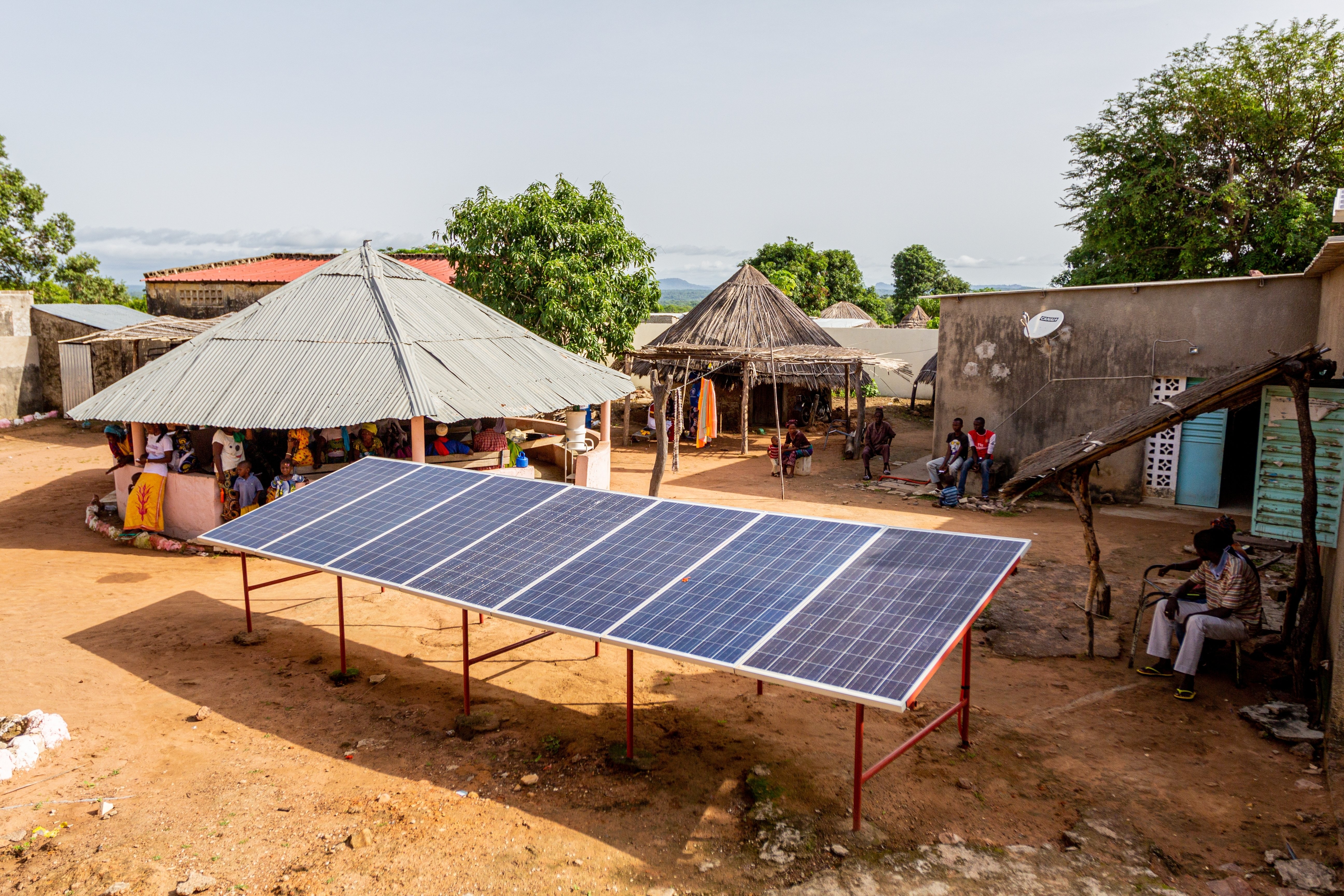
Well, they can be de-linked. I think this is most dramatically the case in, for instance, Sub-Saharan Africa. We talk about an energy transition across the world, but let's be clear, in Sub-Saharan Africa, the use of energy is so small that it's not an energy transition. It's a growth opportunity to give people energy for the first time. There's one exception to that, of course, which is the very significant use of traditional biofuel, literally wood picked up from the forest, which is an incredibly inefficient way of producing heat for cooking and incredibly locally polluting. Apart from that, the energy use per capita of most Sub-Saharan African countries is trivial compared with even most of the middle income developing countries, let alone the developed. Now, we used to think for those people themselves to get energy for prosperity, because prosperity always depends on energy use, that they have to go through a fossil fuel period. But I think the answer now is that solar plus batteries together is such a transformative technology that you can see Sub-Saharan Africa almost completely just skipping the fossil fuel generation. Most people go into the stage where the first car they get will be an electric car. Moving rapidly from the diesel or petrol-based two-wheelers that they have at the moment to electric two-wheelers and using solar plus batteries on a massive scale in the electricity system. Now, interestingly, I couldn't have said this 10 years ago because the costs weren't yet low enough. But I think the costs are now definitively low enough on one condition only, which is finance at a reasonably low cost of capital. Because the fundamental feature of a renewable-based electricity system is that you have more investment up front, and you have a zero marginal cost of running it once you've invested. That means that the relative trade-off between a fossil fuel system and a renewable system depends on the cost of capital. The way I put it is simply this. If the cost of capital in Sub-Saharan Africa was the same as it is in Europe or in the US, I don't think you'd build, you certainly never build a coal plant anywhere in Africa, and you'd build very few gas plants, you'd build renewables. But if it's 10% or 15% cost of capital, you might build gas turbines. And if it's 25%, you'll buy diesel gensets, because diesel gensets are the cheapest thing to buy up front, but they lock you into expensive and dirty fuel over time. So getting down the cost of capital in Sub-Saharan Africa and other low income countries is crucial to seizing an opportunity which now exists in a way it didn't 10 years ago, to just skip over the whole fossil fuel generation.
[18:07] Tom Rivett-Carnac
Adair, this is fascinating. And thank you for setting out that pathway, which as you say, is the most optimistic story that we have on climate and the remarkable reduction in technology costs. But I think that even though we may understand that, I think we can still be pretty disappointed that politics has not followed economics at least a little bit more than it has, right? As you say, we have been blown away by these cost reductions, but the politics has very much moved in the opposite direction. Do you think that that is a bug or a feature of our new world? Is that going to get worked out as the costs keep dropping? Or do you think that in this very confused new information environment, those two might just forever go in different directions?
[18:48] Adair Turner
Well, the points I make in my second lecture is first that we mustn't assume that the world is driven by rational cost economics, but that even in the environment of rational cost economics, we and the, as it were, the climate community who are arguing for action need to be a bit more cautious about where there are costs and we need to recognize them. And anticipate them and management in a way that didn't in the past. Now, partly, the challenges of the last five years, I think action on climate change has been collateral damage as a result of other things which had really nothing to do with climate change. I mean, Putin invaded Ukraine because he believes in a mystical union of the Slavic people which makes it justified for him to sacrifice the lives of 450,000 young Russians and 200,000 or so Ukrainians. That was nothing to do with a pushback about climate change cost, but it had a very significant collateral damage because it drove a big increase in European gas prices, increases in electricity prices. That produced a big focus on cost of living in Europe. That was wrongly, but you can understand why if you're an ordinary citizen. They said, oh, this must be due to the climate change policies, but it just created a harder environment. The more people are under pressure on their ordinary cost of living, because their cost of energy is going up and the cost of food going up, the less willing they are to accept some costs to deal with climate change. Again, I think Donald Trump has an opposition to climate change action, and he is funded sometimes by some very powerful fossil fuel interests. But the absolute core of what went on in the US, I think ultimately was immigration-related and cultural war-related. Climate change is a bit of collateral damage. We live in a world in which things can go wrong, not because of the debate about climate change itself, but because of other things that go wrong. But we do also need to recognize the difference between a complete optimism of where the cost would be in the future and not telling a story that it's a costless transition. Let me give you an example in the UK. Yes, we will get to a stage where we will enjoy electricity in the UK cheaper than we do today. But now we don't because we are paying for some of the early investments we need to make. In order to get those economy of scale and learning curve effects going, we had a regime called the ROCS regime, Renewable Oggregation Certificate regime, which subsidized the early generations of wind and solar, but particularly wind. And because that required a subsidy, that cost had to be met by somebody and it was put on the electricity bills. Now, that wasn't as big as the opponents argue, but it wasn't zero either. So you have to live with this realisation that sometimes there are costs in transition. And by the way, those costs from the rocks, they lasted 20 years after when they were first put in place because that's the contractual length of them. And we need to understand where there are going to be these transitional costs. And we also need to understand distributional effects. Let's take electric vehicles. Now in the UK, it is, and most places around the world, it's already the case that an EV is far cheaper to run if you have a home which has off-street parking and can charge your car at your home electricity rate. And that's true of about two-thirds, about 65% of UK houses. But there's another 35% who live either in apartment blocks or terraced houses without off-street parking. And if they buy an electric vehicle, they charge it at a street or highway-based parking where the cost of electricity is three times the household level. And they at the moment are not able to get a benefit. So we can't tell people everybody is going to win from this, right? We have to know that there will be winners and losers. And politics must always be intelligent about anticipating winners and losers and working out what you do with it. Because the general rule of politics that the winners don't thank the politicians for winning and the losers blame the politicians for losing. That's just an asymmetry within all political processes. And so we have had a problem of things hitting us from outside the climate change debate. But I think we also need to be a bit smarter about anticipating and managing those costs which we do have to face in transition en route to a lower cost future system.
[23:52] Christiana Figueres
In this transition, which is a worldwide transition that we're in, Adair, take just the personality of Trump out of the equation. What is the fundamental contrast between where the US economy is right now and what they might have to do over the next 10 years and what China is doing?
[24:14] Adair Turner
Well, the US., because of politics, partly because of the power of money within the US political system, the power of the fossil fuel lobby, but also because the US has some of the cheapest gas in the world and relatively cheap oil, is at the moment, under the Trump administration, as it were, betting on the future of fossil fuels. And their story to the world is, we've got some of the cheapest gas in the world. That enables us to build data centers and dominate AI. That means you, the American consumer, can heat your home with gas. Methane, I'm talking about there, cheaply. That means we can have relatively cheap electricity and we'll win on low-cost energy from fossil fuels.
[25:07] Christiana Figueres
Wait, sorry. Can they be a gas island into the future? Can they just continue to operate like that?
[25:15] Adair Turner
Well, they can't be. Well, they will typically, they could choose to be. I mean, they could choose to be say, I'm never going to export my LNG. I mean, so there is an option for them to roll forward with relatively low-priced gas. As long as they're willing to export their LNG, their domestic price will be somewhat linked to the international price. That's a choice they can make. A country which is physically energy self-sufficient could choose to say, I'm going to have cheap prices at home. For the American consumer, this gives a short-term benefit. It's a short-term benefit at the expense of a long-term massive strategic mistake. Because China, because it's in a different position, China does have its coal. China, by way, we always have to say this, is now the biggest emitter in the world by far and with emissions per capita higher than European levels by a significant amount and only just now falling. We mustn't over gloss what's happening in China. China has made a bet that the future of the economy is going to be electricity-based, partly because it is committed to the Paris process, it is committed to well below 2 degrees centigrade, it is committed to net zero by 2060, but probably even more because it has identified a set of technologies in which it could win. It looked at the dominance of the European and American automotive companies in internal combustion engines and said, it's going to take us decades to catch up with their technology, but there's this new technology called EVs and we can dominate that. They are absolutely dominating it. They are producing the best, highest quality, cheapest EVs in the world, and they're extending that lead now to freight, which we are going to see electrify at a huge pace. They decided that they don't want to be over-dependent on imported gas or imported oil, so they are driving an electrification of their economy, now reached over 30 percent of final energy demand from electricity versus 20 percent in Europe and the US, and they decided that they could and should be dominant players in solar and wind and increasingly in things like electrolysers. They have made a strategic bet on the electrotech stack, and for the reasons which we discussed earlier, even if in the short run, the US can get a benefit from just exploiting its gas, over the long run, the future is electric, and the future opportunity for technological advance lies in battery chemistry, solar PV chemistry, everything to do with this electrotech stack. I think it is a huge strategic mistake that the US is making, as well as, at least for now, a disaster for climate change action.
Load More[28:25] Christiana Figueres
And India, where do you put India into that equation?
[28:29] Adair Turner
India is an interesting mix. China has a clear target of 2060, and it has a strategy to get there. The Chinese 2060 net zero target has been cascaded down to different institutions within China, and it says, this is non-negotiable, you've got to meet it. I think India has a target of net zero by 2070, but it is not true to say that that has cascaded into a clear set of actions. There are a set of actions going on. There are some very valuable intermediate targets, like the 500 gigawatts renewable electricity by 2030. But they're not put into a clear framework of what is this non-negotiable target and how does it cascade down through the system. On the other hand, in particular things and in a bottom up involvement of Indian companies, there are a lot of good things happening in India. They are now rolling out renewables at a rapid pace. They are at the forefront of developing combinations of renewables, solar and wind and batteries and pumped hydro storage, which enable you to deliver electricity round the clock. And indeed, India have been a real contractual innovator in what's called the round the clock renewable contract, where the developer can't just say, I'm making a field of solar panels and I'll sell you electricity when the sun shines. The developer has to make a contractual commitment to deliver electricity 85% of all hours in the year. So, and India is also driving the development of green hydrogen cost reduction much more than in Europe. So I would say India is an interesting mix of some positive things and less positive things. I would hope that over time there will be a more structured framework of saying, if we're seriously about that 2070 target, and ideally I think that should be a 2060 target, how are we going to meet it?
[30:42] Christiana Figueres
Adair, let's talk about what I call the unthinkable, let alone the unspeakable global temperature increase. So many of us are at a heart and also at our head level, so attached still to the 1.5 for moral reasons, for survival reasons of the islands, for so many different reasons. And then there are quite a few people who are saying, actually we are now beyond 1.5, we are hitting 2 degrees, and I believe that you go beyond that. You are actually saying there is reason to believe that we may hit, as you said at the very beginning of this conversation, that we may hit almost 3 degrees. Talk to me about that possibility, but also what does an almost 3 degree world look like?
[31:51] Adair Turner
Well, I think an almost 3 degree world is really disastrous. We've seen that London is just not a city designed to deal with the heat, which comes with an average global temperature now approaching 1.5 degrees centigrade. But, let's be clear, even significant global warming above that level, rich countries like the UK can probably manage round it. It would be a silly thing to accept. We'd spend far more money dealing with it by putting in air conditioning and completely changing our cities to deal with it, but we'd survive. I think on the North Indian Plain, the Ganges Plain, the heat levels that we are going to see and the humidity levels combined are just going to kill large numbers of people. We're going to get temperatures which, unless you have air conditioning, are unlivable in. I think we are going to see very big changes in patterns of a precipitation which produce droughts and extreme floods, which will exacerbate movement of peoples and migration movements, which are already politically very sensitive and destabilizing. The IPC has set out very clearly the health dangers, the dangers to the economy. I think way back in his Economics of Climate Change, Nick Stern, I think, showed absolutely clearly the reasonable estimates of what the cost, even the narrowly estimated economic cost of, say, a three degree world would be many, many times higher than the maybe one and a half percent of GDP that we have to invest to help stop it. So it is, I think, the idea of accepting that we're heading towards three degrees. And to repeat what I said earlier, the IEA, they try to work out, where would we be if we simply stayed with current policies? And the IEA says maybe 2.9. The IEA has another thing that says, where would we be if everybody put in place the policies that they say they're about to put in place? Maybe 2.5 degrees. BNEF have a scenario which they call their economic transition scenario, which is where would we be simply given what is now in the money in private economics? And that's a bit more optimistic. They're at about 2.4. So maybe they're a bit more optimistic on these technological trends. But none of those are well below 2 degrees centigrade. To get to well below 2 degrees centigrade, you have to assume that not only do we reap the benefit of these low cost technologies, but that we also get enough political agreement to do some things which are costly to do. The costs are not prohibitive, but they're not zero cost. Unless, for instance, we're willing to address the 10 gigatons of CO2 equivalent emissions that come from the hard to electrify sectors of the economy, like air, shipping, aviation, steel, cement, chemicals, aluminium. Unless we got a plan to address those, we will not get global warming, keep it below 2 degrees centigrade. And those, unlike EVs, EVs is part of the good story, right? Over time, if we fix some problems to do with charging infrastructure, this will be a win-win for consumers. Shipping is not going to be a win-win for consumers. It's going to be more expensive to run global shipping on ammonia and methanol than marine oil. And we're going to have to accept that cost in some way. The good news is the cost in terms of what it actually does to a cost of a pair of jeans made in Bangladesh and bought in London is pretty trivial, but it's not zero. So we, and this is one of the things the ETC is now doing. We're doing a piece of work which we call Protecting Paris. And we're focused on trying to work out what will it take for the world at least to limit global warming to well below two degrees centigrade. Now you can debate what well below two degrees centigrade means, but let's suppose it means about 1.8. We're working out from the sort of mid twos, the 2.4 or 2.5 to which we may be heading at the moment on the basis of economics or stated policies. What is it that we have to do definitively to get to 1.8? Then the thing to add is, and it goes back to the 1.5, we can't limit global warming to 1.5 over the next few decades. I think that's baked in. I think it's highly likely that over the next five years, the average of the next five years will be slightly above 1.5. There will be an overshoot. If we take the actions that could keep it well below two degrees centigrade, we will also be in a space where if we could agree in the second half of the century, large removals, we will be able to claw our way back to 1.5. I think that's what we have to think about. What are the actions which if we take, we know can limit it to well below two degrees centigrade and to know that if we do them, we will have the option of getting back to 1.5, though it will require global agreement on who's going to pay for removals.
[37:17] Tom Rivett-Carnac
Adair, this is so interesting. I'd love to just ask you as a final question. I mean, there are technical steps we need to take to protect Paris and to get us down from where we're heading to where we need to be. Not all of those are going to be immediately cost-effective. Some of them are going to require investment for a livable future. What pathways politically do you see at this moment for us to do that? Because we need to bring politics with us to make this happen. We're not seeing a prioritization in many countries in the world. If we were to rebuild that political alliance that would be necessary to do the extra bit to get us below two degrees, what's the pathway to that? Do you see any bright spots in that?
[37:55] Adair Turner
I think I divide the 50 gigatons of CO2 equivalent that we have to eventually get to zero into three groups. 30 gigatons is in segments of the economy which we will almost certainly electrify at some point and where the crucial issue is how fast do we do it. This is the whole of EVs, this is residential heating, this is low and medium temperature industrial heat, the sort of industrial heat at 100 degrees, 200, 300 that you get in the brewing industry, the food processing industry. There's then another 10 gigatons, which comes from those hard to electrify sectors. And then there's another 10 gigatons that comes from food and land use, methane emissions from cattle, deforestation driven by red meat production. And so I think one needs to think about how do we get global agreement on measures which can attack each of those three blocks? The good news on the 30 gigatons, which is electrifiable, is that we're going with the flow of technologies in our favor. Costs recaptions coming down. And I think here, and this will be important at COP 31 in Turkey, I think getting as many countries as possible to grab the idea that the future is electric, to set electrification targets, to try as much as possible to have policies that drive that electrification of those clearly electrifiable sectors as fast as possible. I'm hopeful that we will see it to care, not, I think, within the formal negotiation. If we can get a large number of companies to be signed up to saying, we recognize that we have a suite of technologies which are capable of being lower cost as well as lower emissions. And the way to get them lower cost is to turbocharge their deployment, because that drives the economies of scale. That's what we need in all those electrifiable sectors of the economy. For the other 10 gigatons in the hard to electrify sectors, I think, and I hope we will have this debate at Turkey, we have got to debate global carbon prices or global regulation. You cannot decarbonize iron making without accepting a green cost premium, which means decarbonizing iron making is only economic if there's a regulatory requirement or a carbon price. If you have a carbon price in one continent like Europe, you're going to have to have a CBM because otherwise, you're going to fool yourself. You're not decarbonizing, the production will just move somewhere else in the world. This whole debate about how do we get global agreement that not in all sectors of the economy, but in these specific hard to electrify sectors, we need a framework of either globally agreed national carbon prices, which I think is how we have to go in iron and steel and cement. They will be national carbon prices, but we can debate a level of coordination. In shipping and aviation, we ideally want global carbon prices. Now, we know what happened over the last year. The International Maritime Organization had, I think a very good plan to introduce what was effectively a form of carbon pricing in the International Maritime Sector, which had it been put in place, kept in place would have driven major change. It was undone last October in London by the lobbying of the US and also by the Saudis. But IMO can proceed on a majority basis. I think we got to have the guts to just say we're going ahead. The rest of the world which wants to deal with this climate change problem is going ahead in that sector whether the US likes it or not. So turbocharged electrification where we're going with the thrust of technologies in our favor and a possible win-win, and have a real debate about how do we get carbon pricing and regulation to make it economic, to drive the decarbonization of the hard to electrify sectors. Those two things in Tokyo, I hope they will be part of the discussion and agreement outside the formal negotiating rooms.
[42:19] Christiana Figueres
Can I just squeeze in one last question, cheeky question here, Adair? The, what I call the have to abate, not hard to abate, but I call them the have to abate sectors. How high do you estimate the global carbon price has to be in order to have an impact on the have to abate sectors?
[42:40] Adair Turner
Well, interestingly, we're doing a piece of analysis right now, with the China Iron and Steel Research Institute. So we are doing a piece of work which says, how low do they think in China they can get the cost of green hydrogen? How low therefore can they get the cost of making iron through hydrogen direct reduction? And how high therefore will they need a carbon price in China to drive that? Here's my gut feel at the moment. I suspect that if we had, from past analysis, I suspect if we had a carbon price of $80 a ton, $100 a ton, if that were globally agreed rather than just one location, we would begin to make serious inroads into iron making and cement. I think the prices are higher for aviation from sustainable aviation fuel and shipping. They're more up in the couple of $100 per ton. That, of course, raises perfectly legitimate issue as to whether we need to force them to decarbonize entirely within sector or if we could have removals which are available at $100 a ton, do you still allow them to use the conventional fossil fuel route, but offset it at $100 a ton rather than taking $200 a ton within sector itself. I think we should be open to that because we shouldn't pile on unnecessary cost.
[44:11] Christiana Figueres
Adair, thank you so much. Thank you for spending all of this time with us, and thank you for all the analysis and work that you have done over so many years.
[44:26] Tom Rivett-Carnac
So great to finally get Adair Turner on this podcast. We've been wanting to do this for a long time, so great to have that conversation. I hope you enjoyed it as much as we did. So Christiana, we've got a few minutes now to delve into some of the key issues that came up, and I wonder if we should start about the argument that is made by Adair, that the climate community has kind of oversold a costless transition, and now has to be honest about the real costs and the winners and losers. I mean, in the past, there were transitions, and they required public investment in order to precipitate real change. And maybe it sort of speaks to a little bit of underconfidence that those in the climate community that have been advocating for this shift have kind of assumed that, you know, there can't be any cost to it, otherwise it won't be possible. Do you think that we've undermined our own argument by sort of downplaying the necessity of investing in a big shift like this?
[45:20] Christiana Figueres
I think actually we haven't been very prudent in almost assuming that this would be a costless transition, as he puts out. And he puts out several arguments to which I would like to add some as well. The first, of course, is that there are winners and losers, and that those who self-identify as losers will be obstreperous and resistant and doing everything that we see the oil and gas industry doing. So we should have thought that that was going to be a huge pushback. Secondly, the ones who have actually been underlying the cost of this transition is everyone who has been arguing about it has to be a just transition. Do not leave those who are dependent on the fossil fuel industry income because they're working there, do not leave them out, do not leave out the people who are most vulnerable. The just transition argument and the champions of that argument have actually been the ones that I would say have been most clear about the cost of this transition. And the third piece which Adair only just sort of touches upon tangentially, the cost of completely unforeseeable events. We have assumed that the transition, because of the winning economics, we have assumed that that transition will almost be linear if not exponential, which is what I personally have been saying, and we say it a lot on this podcast. But we have to recognize that even though the economics and the technology are moving forward exponentially, the fact is there are many completely unforeseeable events, such as the invasion of Ukraine, that affect that curve, that exponential curve. So we have just been a little bit too blind, if you will, or imprudent in assuming that the economics and the technology would just have an easy ride.
[47:45] Tom Rivett-Carnac
Yeah, so I think that's a good analysis. But I wonder also, you know, if you see, I mean, this might be a silly example, but if you see a politician get pressed by an interviewer in an interview or something, and they're sort of ducking and diving and dodging the question and trying to kind of wriggle out of it, and then sometimes you see already seasoned politician and they like own up to something and they say, yes, we've got challenges, but those challenges are surmountable. Nothing is free. We're all grownups. We understand that actually you need to make investments. Change is difficult, but it's worth doing. Let's try and do it together. Even just that kind of narrative approach is not something we have seen as a baseline tone from the climate movement, always. In some cases, of course, we have. And maybe that has made us less powerful. Do you think that's fair?
[48:32] Christiana Figueres
Yeah, I think I almost want to say, well, we have actually always underlined both the outrage and the optimism of this transition. Sorry about that, but...
[48:46] Tom Rivett-Carnac
Nice. We like to be a bit slightly self-promotional, Paul Garth.
[48:48] Christiana Figueres
Yes, I am slightly self-promotional. But I would agree with you, Tom, that the easy route is actually to either disappear into the rabbit hole of the outrage and the completely undoable or be sort of in la la land. And the balance between the two, and not just the balance, but actually shine the light on both sides of the reality, is the piece that I think we all have to own up to.
[49:24] Tom Rivett-Carnac
Yeah. Yeah. Nice. I like that. Okay. Just delving into a few other things that came up in that interview, I think he's particularly interesting on the rise of China and the role that China is going to play in the coming years. He made this big point that the US is basically making a bet that with cheap gas and the fossil fuel lobby, they're going to have fossil fuels for AI, heating, electricity, but that actually in that, Adair sees a real long-term strategic mistake. China has made the opposite strategy. It's okay now the biggest emitter at around 30 percent of the global total, but it's bet the other way. It dominates on EVs, on cost, on quality. The per capita emissions are above Europe's and only now just starting to fall. But what he makes a very clear distinction around the direction the US has taken and the direction China has taken. Do you buy his analysis and do you think that that trajectory is now locked in?
[50:24] Christiana Figueres
Yeah, we've been referring to this quite often on the podcast, so I would say yes, we do agree with him. Is it locked in? I think that depends on how much damage this administration in the United States can make over the next 2.5 years. If it can really destroy the basis of the clean energy manufacturing and industry in the United States, then that is going to be irreversible. I think in the first administration of Trump, we thought, okay, hold your nose and the US will have to play catch up. The big question now after the second administration, will they be able to play catch up? That is really remains to be unknown. But the other question that I think really deserves going into is, what is the role of India? Adair just turns to India very quickly and says, they're not quite as clear as China. But honestly, Tom, if we are to succeed, we need a country the size of India to also be walking down this path, if anything, just because of the per capita. India is neither as clear on the path as China, but also is not being as resistant as the United States for sure. But it hasn't taken the clarity of China. That to me is where a lot of the future lies. If China and India move forward in an accelerated fashion, then I wouldn't go as far as saying the United States becomes irrelevant. But what it does do is it accelerates the leadership of the developing world in ways that are then truly unstoppable.
[52:20] Tom Rivett-Carnac
Yeah, so interesting. So would you say India is a kind of fascinating case study that perhaps would merit a deep dive series of Outrage and Optimism episodes at some point in the future?
[52:29] Christiana Figueres
Well, of course, that's what you wanted me to say.
[52:33] Tom Rivett-Carnac
So this feels like a great moment to make the point that unless Ben edits it out, then very soon there will be a multi-part special on India. I was there a few months ago. And it's just such a fascinating dichotomy between, you know, the challenges and the opportunities moving forward, but also dealing with many legacy issues. But that is coming, and that's something for listeners to look forward to. So I wonder whether we should just give the final word to the three-degree world that he projects that we're heading towards, and how we now move forward and protect Paris. What do you think?
[53:08] Christiana Figueres
Protect Paris.
[53:10] Tom Rivett-Carnac
I mean, he makes the point that three-degree worlds is disastrous, and that wealthy countries could maybe adapt to the high cost, but places like the Ganges Plain would just face lethal heat and humidity, and we've talked many times about that opening scene of the Ministry for the Future. Of course, alongside droughts and floods and migration, he sort of sees 1.5 degrees as an overshoot, which is now baked in, that we can maybe claw back with removals, and we've gone into that in some detail before. And the route forward now runs through carbon pricing and regulation for the hard to electrify sectors, maybe border adjustment tax to stop production being relocated. And he points out that 1 of the real places we can move forward actually is company level action, and that the willing majority should press ahead, even where maybe the US or Saudi Arabia are blocking progress. Do you think we've reached a point, and again, this is a topic we've come to many times, where actually if we are to do what we need to do, it's going to be these sort of plurilateral coalitions of the willing. I think he doesn't say it directly in the podcast, but I think Adair has maybe moved away a bit from believing the COP process is going to step in and provide us with a pathway forward.
[54:19] Christiana Figueres
Yeah, reminiscent, of course, of Mark Carney's call to middle powers to do their job, middle powers being interpreted widely, not just middle economies, but also all other stakeholders. But you know what, Tom, I have to admit, when you said Protect Paris, I kind of lost a few breaths there because everything that you said since then, I totally agree. And it is not about that. It is about protecting the most vulnerable people and the most vulnerable non-human species on this planet. That is what it's about. It's not about protecting a legally binding statement that was adopted in Paris. It's not even about these numbers, it's not even about the data points underneath all of that. We have to be able to go under all of that and not get lost in the data to understand that this truly is about protecting those populations that are most vulnerable, most innocent of the damage that we have incurred. And the fact that we're running out of time to do that, the fact that we may soon be to the point where 1.5 is not just an overshoot. But what if it becomes a permanent reality that we really truly are above 1.5? The consequences of that are so unthinkable, so unthinkable. And as you say, first chapter of the brilliant book Ministry of the Future. That is exactly what should be guiding us now.
[56:20] Tom Rivett-Carnac
Great. Okay, well, unless you have anything else burning, that probably takes us to the end of this episode. Great to have Adair on.
[56:27] Christiana Figueres
Burning. We're all burning, Tom. This is a really, really hot year and will continue to be a hot year.
[56:36] Tom Rivett-Carnac
I mean, I don't know about you, but I've done so much media this summer and there's a sort of slightly different tone where the interview is gonna say, is this gonna help? Will this be the moment that all this unbelievably abnormal hot weather, particularly in Northern Europe, at many places will make a change? And you sort of almost hear a bit of a longing in people to sort of say, will this be the moment we kind of come together and make something different? I always reply in the same way. It can be, but it doesn't have to be. And we're the ones who are gonna have to make that difference. So yes, maybe burning isn't the right word. Anything pressing, then I think we should draw to a close. Fantastic to have Adair Turner on. Lovely to see you. Thanks for listening, everyone. See you next week.