









379: What’s India Building?: Tales from the Biggest Transition on Earth
"This will never work in India." That's what Indian truck manufacturers said about electric freight. Now they build the trucks. Something is going on here at a speed the rest of the world has not yet noticed. Solar capacity has gone from under three gigawatts to more than 160 in ten years. Across the same decade, 171 million people moved out of extreme poverty. But in eastern Delhi, a woman who has lived beside an open mountain of garbage for fifty years asks Tom Rivett-Carnac for one thing: tell the world about us.



About this episode
So, in the second of three episodes from India, Tom goes looking for what is really driving this change, what it looks like up close, and whether it can deliver for the people who need it most.
A cement executive who set a net zero target in 2018, when nobody else in his industry had, will give you the business case that green is profitable. Ask him what is actually driving him and he gives a different answer. Truck drivers on the Bengaluru highway who are not called drivers any more. A nine-year-old with a bicycle. This is the largest transition of its kind anywhere on earth, and it is happening right now.
With Delhi-based journalist and filmmaker Adnan Bhat on the ground, and Dia Mirza, Shyla Raghav and Prachi Shevgaonkar on what it all adds up to.
So what does it look like from the inside? And what happens to the people it hasn't yet reached?
Disclosure: the electric freight programme in this episode, Laneshift, was founded by The Climate Pledge, which Global Optimism co-founded with Amazon, alongside the city network C40.
Learn More
⛰️ Read how Delhi's garbage mountains became heat bombs for the people who work them, Al Jazeera on the waste pickers of Ghazipur, a landfill now roughly as tall as the Qutub Minar
💧 Watch The Waterman of India, Decode Mediacom's film on Dr Rajendra Singh, whose johads and check dams have revived five rivers across drought-hit Rajasthan
🧊 Watch Sonam Wangchuk build an automated ice stupa, the artificial glaciers that freeze winter water into towers and release it when Ladakh needs it in spring
🌾 Learn more about Andhra Pradesh's natural farming programme, which has moved more than 1.7 million farmers off chemical-heavy methods and won the 2026 Food Planet Prize
🏗️ Understand why cement is so hard to clean up, from the Chatham House
🗳️ See what Indians actually think about climate change, the Yale programme's opinion maps covering 634 districts
🎤 Leave us your voice notes and questions for upcoming episodes on SpeakPipe
Join the conversation:
Instagram @outrageoptimism LinkedIn @outrageoptimism
YouTube @OutrageandOptimism
Or get in touch with us via this form.
Senior Producer: Ben Weaver-Hincks
India Producer and translator: Adnan Bhat
Show Runner: Caitlin Hanrahan
Exec Producer: Ellie Clifford
This is a Persephonica production for Global Optimism and is part of the Acast Creator Network.
Full Transcript
Transcript generated by AI. While we aim for accuracy, errors may still occur. Please refer to the episode’s audio for the definitive version
[00:00] Tom Rivett-Carnac
Hello, listeners, this week we're going to bring you the second in our three-part series on India, the remarkable transformations and the challenges that are happening in that country. But we couldn't begin the episode without making some comment about what's been happening in Nepal, the terrible loss of life and human suffering as a result of the landslides and the resultant floods that swept down those valleys. We've all seen the news articles, and we've all been horrified. The Himalayas are warming at roughly 50% faster than the global average. And that is leading to massive destabilization. As the permafrost thaws, these mountainsides become increasingly destabilized, and as we've seen, they can fall with little warning. Heartbreakingly, as the warming continues, this is the kind of impact that might accelerate, which only underlines the necessity of doing everything we can to reduce emissions, to restore nature. Thanks for joining us this week. We'll be talking more about this in a future episode. Do you think that there is a difference in driving an electric rickshaw to driving a regular rickshaw? Easier to drive, yeah.
[01:07] Unidentified (Rickshaw Driver)
It doesn't cost as much when it takes time to charge this thing.
[01:10] Unidentified (Rickshaw Driver)
But yeah, it's better than the troll or CNG.
[01:13] Tom Rivett-Carnac
Last week in Delhi, we ended with rickshaw drivers who'd gone electric because it provided a better livelihood for them and for their families. This week, we go back to India for the second of our three episodes. And that's the thread I want to follow up on. What's really driving India's transition? How does it show up in people's lives? And can the economic opportunities it presents really be experienced by all who need them? I'm Tom Rivett-Carnac, and this is Outrage and Optimism.
[01:47] Dia Mirza
Everyone wants to modernize, and the idea of development is informed by an economy that has shaped development the world over.
[01:59] Tom Rivett-Carnac
That's Dia Mirza. She and I talked at length as part of making these episodes.
[02:04] Dia Mirza
And so many of us are struggling to understand what is that model of development that we really want. Is it one that supports and protects ecology and therefore ensures and guarantees access to fresh water, health, a healthy climate, and a future that can sustain all of these people that live on this land and breathe its air and drink its water and, you know, grow its food? I think it's dichotomous, it's contradictory, it's messy.
[02:44] Tom Rivett-Carnac
India is in the midst of another major transition right now. Since 2000, the country's extreme poverty rate has plunged. It's gone from over 40% to just over 2% according to World Bank data. Now that is a stunning achievement and one that most people did not think India was going to be able to make. But with that pace of change, there are of course still major challenges. Many people in India now find themselves only just above that poverty line, and there are big regional imbalances across this huge country. Many talk of a missing middle class, with the country divided between a wealthy consumer class, fueled by booming sectors like tech and financial services, and a vulnerable majority who work in wage jobs or on the land. Now, of course, last week we were looking at people in the capital Delhi. But India is not mostly a country of cities. Mahatma Gandhi famously said that the soul of India lives in its villages, and despite the incredible changes of recent decades, that may well still be true. Despite being the fastest growing major economy on earth, 6% or 7% a year, two-thirds of India's citizens still live and work in rural areas. Compare that to China, roughly two-thirds urban, or Brazil, nearly 90%. Here's Shyla Raghav, former chief climate officer at Time.
[04:09] Shyla Raghav
What we know is that rural populations in particular are more vulnerable and sensitive to climate shocks just because their livelihoods are oftentimes interdependent with climate-sensitive sectors. And you can think about failed crops, water stress, extreme heat, debt, migration, and all of the health implications of these climate stressors that are more acutely affecting rural populations. And that's why climate resilience matters so much. For many families, climate change is already shaping, whether they can stay on their land, whether their children have a secure future. And because so much of India's economy is dependent and the social fabric is tied to land, to the water and seasonal stability, these shocks really travel quite far.
[04:54] Tom Rivett-Carnac
With all these drivers, the pull to the city can be really strong. Some people go permanently and others migrate seasonally to follow better paid work that fluxes throughout the year. A rural worker is likely to earn less than a city one for similar work. And the shocks Shyla describes fall on the same farm incomes most of the country still depends on. To avoid the hollowing out of rural communities, there is real work going on to reverse this shift.
[05:22] Shyla Raghav
One of the most inspiring movements that I've seen in India that's connected to Natural Solutions is this concept of reverse migration, which is a movement to keep people in their communities so that there's continued opportunity for economic development and growth and income generation that supports the entire economy in these regions. What migration tends to do is not only is there a drain of labour and of individuals, but it's oftentimes heads of households. And the entire social fabric falls apart. So what's been really interesting is this increased understanding that in order for people to continue their lives with dignity, oftentimes that means helping them stay where they are, where they feel the most fulfilled and where they're able to continue to maintain their livelihoods.
[06:11] Tom Rivett-Carnac
If people are going to stay though, there has to be something for them to stay for. And part of that is bringing the land itself back to life.
[06:19] Shyla Raghav
The other thing that I've seen a lot in India is movements towards watershed restoration. And in very arid regions like Rajasthan, there's work of really trying to restore riverbeds and restore rivers, where you see rivers that have entirely dried up are now coming back through ecological restoration, through stormwater retention. And these have had a material effect on improving the livelihoods in these rural populations.
[06:46] Tom Rivett-Carnac
There are now so many examples of nature being brought back by the efforts of people in rural areas and villages all across India.
[06:55] Unidentified (Rajasthan Villager)
The area used to be dry, drought-prone, and totally barren three decades back. Drinking water was not available.
[07:03] Tom Rivett-Carnac
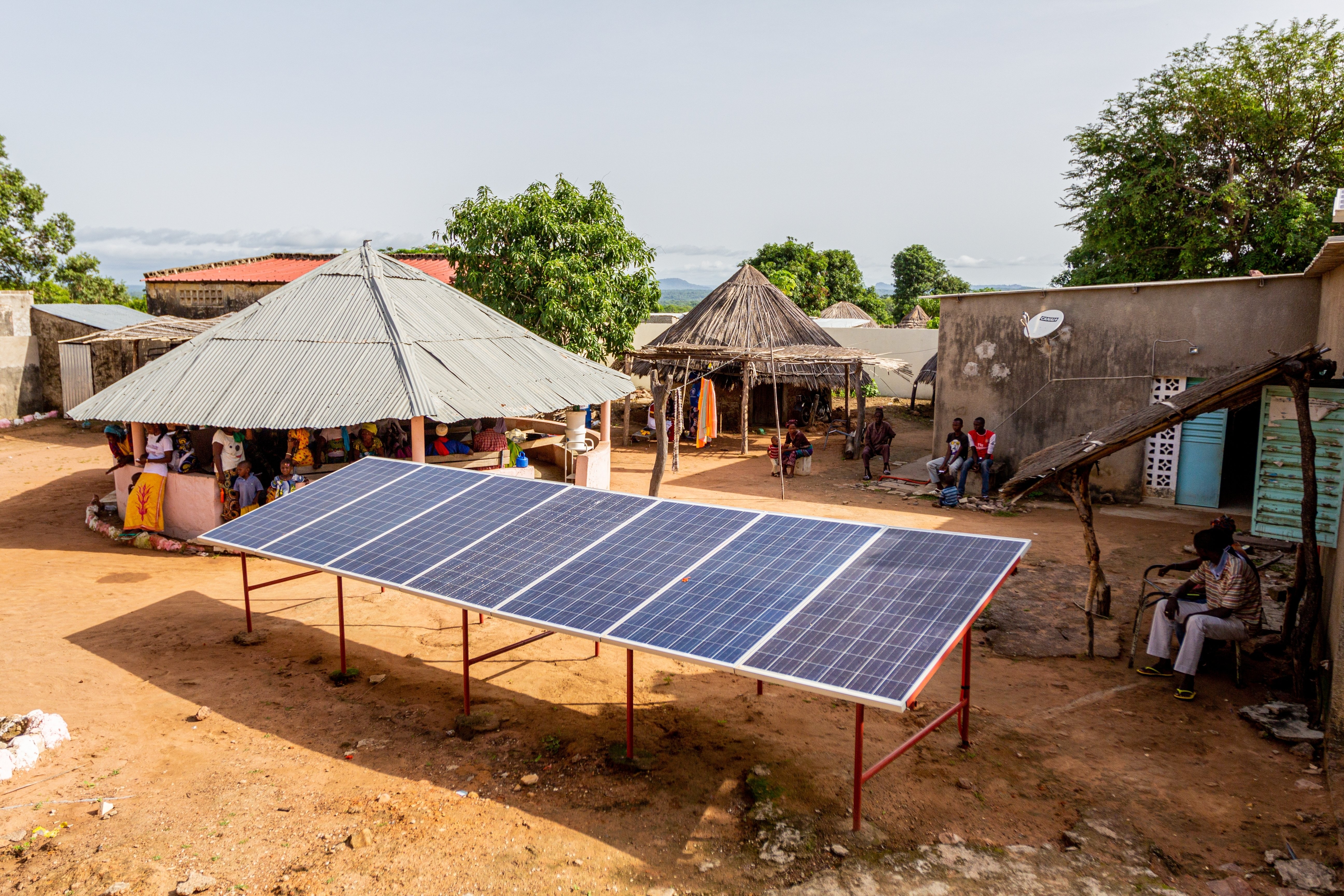
In one part of Rajasthan, villages brought back a river that had been dry for nearly 60 years by building hundreds of small dams, enabling it to catch more of the monsoon. In Andhra Pradesh, a state programme has moved more than a million farmers off chemical-heavy methods onto natural farming, working with the soil.
[07:22] Unidentified (Andhra Pradesh Farmer)
In 2014, Andhra started off on an ambitious mission. No chemical fertilisers or pesticides.
[07:28] Tom Rivett-Carnac
It's thought to be the largest scheme of its kind anywhere in the world. And restoring the land isn't only a local good. It's part of how the country plans to hold its emissions down. The forests in India are a huge store of carbon. And the country is closing in on a big 2030 target for expanding them further. And it looks likely to hit that target. The idea underneath all of this is an old one.
[07:54] Dia Mirza
Mahatma Gandhi saw it. He called it. He said it. You know, his call for Swadeshi. What was it? Support local, grow local, thrive locally, you know. That is what is really going to build a world that is equal and fair for everyone. And more than anything else, a world that is safe and inhabitable and healthy for everyone.
[08:23] Tom Rivett-Carnac
Many of these solutions can be incredibly inventive. When I asked Shyla for an example, she reaches for an engineer high in the far north of the country, and one idea among many.
[08:35] Shyla Raghav
Sonam Wangchuk, he really has broadened our idea of what climate leadership and education looks like. He's an engineer, an educator, an innovator from Ladakh, which is a northern region in a mountainous part of India. And he has really championed and brought back this traditional practice of glacier grafting into modern ice stupas in mountain communities to manage water scarcity and glacier retreat. And his stupas have produced 264,000 gallons of water at a time when water scarcity and accelerated glacier melt is threatening water security in these regions.
[09:17] Tom Rivett-Carnac
I think one of the things this illustrates is that these traditional practices in India can really help solve modern problems and they're uniquely Indian solutions. So what's the answer to the question that Dia posed earlier?
[09:31] Dia Mirza
What is that model of development that we really want?
[09:34] Tom Rivett-Carnac
The question of the model of development cannot be divorced from the concept of justice. India is a country that has now been free for 80 years from colonial rule. That colonial rule that was imposed by my country, Britain, took place over 200 years. During those two centuries, enormous amounts of wealth and value were extracted from the country, along with inflicting enormous amounts of human suffering. Before the British arrived, India was probably the greatest economic power in the world. When the British left, so much of that opportunity and possibility had been stripped away. I reiterate this here because traveling around India, it became evident to me that so much of this history still shapes the world that we live with today. And we in the West don't think about this enough. This legacy is a fundamental part of understanding the world as it is today. This needs to be taken account of when we look at development and we look at the world that we want to create, if we are going to move towards a safe, regenerative future. We're just arriving at the Ghazipur landfill, which is the very famous open landfill where so much of the city's municipal waste goes. And it's picked through by human beings to recover astonishingly 56% of all the recyclable materials that aren't sorted in the city. All the material comes here and the waste pickers go through and take a lot out and they scratch themselves a living. Most of India's municipal waste is still sorted by hand, by a workforce running into the millions. I wrestled with whether to visit a landfill while in Delhi. I didn't want this series to tell the same story we've seen on the news of all the challenges and all the problems, but I also wanted to ensure that we told the real story of humans on the ground and what is actually happening in the midst of this transition.
[11:30] Adnan Bhat
Okay, so everywhere in this neighborhood, somebody in the family has some issue when the elders can't come out of the house once summer hits, it's so bad.
[11:40] Tom Rivett-Carnac
While in Delhi, we worked with a local journalist and filmmaker, Adnan Bhat. You've met him already and you'll hear him throughout this series. He really felt it was important that we visited. Ghazipur is one of three municipal waste sites that ring Delhi and has taken much of the city's waste since 1984, around two and a half thousand tons of it a day, with 150,000 people living in its shadow. Adnan, you're a journalist and a filmmaker, we've been working with you since we've been here. As part of this time, we've been telling a story about air pollution, telling a story about climate, and you've been very keen that we come here to the Ghazipur landfill. Why were you so keen that we come and see this?
[12:19] Adnan Bhat
Two reasons. One, because I wanted you to see, meet people who live here, who face, of course, air pollution is a global problem. It's not a regional problem, or it's not a local problem. It's a global problem that we face. But there are pockets in Delhi where it's worse. When we talk about air pollution, we look at the heavy metals in the air, we look at how the impact it has had. So there are parts in the city where there's still green cover, there's still people who have access to air purifiers, who have certain luxuries which can still shield them from what is out here happening right now. So I wanted you to come here and meet these people who live on the fringes of this massive waste mountain and which sends out gases into the atmosphere and makes their lives hell. So that was one reason that I wanted you to meet these people. And the other reason is, again, this also tells a story of the inefficiency of the authorities who promise every year that they're going to make it better. And this is the image that perhaps can tell it better than anybody else, that this is here in the middle of the capital city and it's been here for decades and yet nothing can be done about it.
[13:36] Tom Rivett-Carnac
Adnan's right that the mountain has outlasted a lot of official promises to remove it. A contractor is promising to clear the whole site by 2028, about a third of it is gone already but it has been incredibly slow and the deadlines have not been consistently met. The waste still arrives faster than anyone can shift it and few people here believe that it will ever truly disappear. While there we meet the woman who heads the local residents association. She's a political activist and a mother, part of the mostly Muslim community that has grown up in the shadow of the waste pile. Many of them are migrants from poorer states in India or from neighbouring Bangladesh. She's lived here 50 years, since before it was a waste pile at all. She speaks in Hindi and Adnan translates.
[14:29] Adnan Bhat
She's basically saying that, you know, like, when you go out, please tell our story to the world because, you know, like people do not care about us. Nobody here in the city cares about them. No politician cares about us. Like, we have been facing this for many, many years. So once you go to your country, back to the world, please do not forget about this story that this is happening to us. And like our politicians go around the world, they tell around the world that India is a great place to live and be and do business. But look at us, we've been fighting for 50 years and nothing has changed. Just tell the world what is the reality of being here in Delhi. Unless you're not rich, this is where you have to live.
[15:10] Tom Rivett-Carnac
Across town, my thoughts begin to move, not to what we've done in the past, but what India has to build next. India is growing. The population is projected to peak around 1.7 billion people sometime in the 2060s. That's 200 million more people in little more than a generation. To this end, the country is in the middle of the largest government funded housing program in history. Almost 50 million homes in rural areas alone are to be constructed. And that's just a fraction of what's coming. On some projections, about 73% of the building stock India expects to have in 2050 has not yet been built. One person working on this is Mahendra Singh. We meet him at a summit India has hosted for 25 years, the World Sustainable Development Summit. It's a world away from the place we've just left across town. Mahendra is the Managing Director of one of India's largest cement groups, Dalmia Bharat. Cement is responsible for something like 7% of the world's CO2. Making it releases carbon twice, once from the fuel that heats the kiln and again from the chemistry that turns limestone into clinker. Getting the transition to low carbon cement is going to be really important for India's overall transition, since the country is the second largest cement emitter globally. Even though the total emissions are still low on a per capita basis.
[16:38] Mahendra Singhi
Our Prime Minister declared its intension that in COP26 in Glasgow, first he declared that we will be having 350 gigawatt of renewable power, when we had only 20-30 gigawatt.
[16:53] Tom Rivett-Carnac
That was huge.
Load More[16:54] Mahendra Singhi
Yes. And thereafter, he announced it to 500 gigawatt. And thereafter, we have seen the big progress. Solar power is one of the major contributor for energy transition. And WindCore also came into picture. So what we are seeing is that because of the high capacity, which is being constructed here, the prices when it was 10 cents power cost.
[17:20] Tom Rivett-Carnac
Yeah.
[17:21] Mahendra Singhi
It has now come down to about 4 cents now.
[17:25] Tom Rivett-Carnac
He counts three leavers. That cheap solar, firmer round the clock power from new hydro, big batteries and the small modular nuclear reactors the government has just opened to private firms and green hydrogen.
[17:37] Mahendra Singhi
Green hydrogen, which used to be like 6 to 8 dollar a kg. Now it has come down to 3 to 4 dollar and which may come down to 2 also. So government came out, you know, when government has to focus, and they come out with mission, mission philosophy.
[17:56] Tom Rivett-Carnac
These rapid cost reductions have let his company make big promises.
[18:00] Mahendra Singhi
We were one of the first cement company and one of the first industry globally to declare our net zero carbon negative road map in 2018, when hardly anybody was talking about it. So that was a great surprise to everyone. And that was not also being digested by, you know, many global cement companies of Europe and US, that how they can do it. But then the levers which we identified at that time by reducing energy consumption, by using more and more waste product as a raw material, by putting up a waste heat recovery system, by using renewable energy, by replacing fossil fuel and using carbon capture and technology also. And we created a philosophy, clean and green is profitable and sustainable. And then our company proved it, that my profit is one of the highest in cement sector in India. And my carbon footprints are lowest. So we do say that climate strategy is very good business strategy.
[19:06] Tom Rivett-Carnac
And indeed the strategy is working. Independent reporting put Dalmia's emissions per tonne among the lowest in the industry, showing that it can be done, even in a hard to abate sector like cement. The same argument that the clean way can be the cheaper way is being tested right now on India's roads. As India grows, both as a consumer and a producer, more stuff needs moving around. And currently, almost three quarters of India's freight goes by road, on trucks that nearly all run on diesel. A program called Laneshift set out to change that a few years ago. It was set up in 2023 by The Climate Pledge. That is a big global commitment to get to Net Zero 2040, that Global Optimism, my organization, set up together with Amazon. We started Laneshift along with the Citi network, C40.
[20:00] Mathsi Kutty
Laneshift is basically trying to accelerate freight decarbonization. And what that really means is debunking the myths around electric freight and also trying to fast track the deployment of electric or zero emission trucks in India.
[20:17] Tom Rivett-Carnac
That's Mathsi Kutty, one of the people working on Laneshift from The Climate Pledge. She and her colleagues know well that electrifying a truck is much harder than electrifying a car. One of the biggest challenges is the batteries, which need to be big, heavy, and cut into the load the truck can transport.
[20:34] Mathsi Kutty
In simple terms, it's about reimagining the freight shipping by replacing diesel trucks with electric trucks and building all the infrastructure that is needed to support them. We are taking an ecosystem approach, trying to get all the stakeholders like the electric truck manufacturer, the shipper, the logistic service provider, charge point operators all together and identify what their specific challenges or barriers are.
[21:04] Tom Rivett-Carnac
Electric trucks also need serious charging power out along the highways, and they can cost two to three times a diesel one. And that can be difficult in a business run mostly by small family firms with little spare cash. But get it right, and the prizes can be huge. Here's Mathsie C40 colleague, Sarika Chakravarty.
[21:24] Sarika Chakravarty
In India, while freight comprises of only 3% of the vehicle population, it contributes to over 30% of the air pollution, the air pollutants, the PM25 particulate matter, the NOx pollutants, etc. So we saw this as an opportunity where we could also meet our objective. Of course, it was a new domain for us because for freight, we had to step beyond the city's jurisdiction and work with the national and sub-national governments, but it has been a great learning for us.
[21:55] Tom Rivett-Carnac
Beyond the PM25 and the nitrogen oxides, road freight is one of the fastest growing sources of India's transport emissions. Shifting it could keep billions of tonnes of greenhouse gases out of the atmosphere over the coming decades. So Laneshift looked to the highway between Bengaluru and Chennai to prove that it is possible.
[22:15] Sarika Chakravarty
The complexities were many, because when we started in 2023, there was absolutely nothing in terms of ecosystem maturity in India, okay? While India is foring ahead in terms of electrification of its vehicles, we are focusing more or rather we are seeing more growth in the two-wheeler, three-wheeler passenger vehicles with e-buses which constitute of the public transport.
[22:40] Mathsi Kutty
What really started off as a pilot where we said, let's do 600 commercial trips along the Bangalore-Chennai corridor, it would be about 200,000 kilometers that we would clock in. But by the end of the pilot, we were actually able to run about 3,500 commercial trips, as in the program aided the confidence in companies. And there were 3,500 trips that were commissioned and that covered about 2 million kilometers. So once the business has experienced it, the demand just kept following.
[23:15] Sarika Chakravarty
The truck manufacturers, when we spoke to them first, they were like, this is a concept which will only work in Europe. This is quote unquote, this is what we heard from them, this will never work in India.
[23:27] Tom Rivett-Carnac
These are Indian manufacturers?
[23:28] Sarika Chakravarty
Yes, these are Indian manufacturers. Now it is the same manufacturer who is now developing other models of e-trucks because they see the success and the demand because of our experiment on the Laneshift.
[23:41] Tom Rivett-Carnac
This story of the Laneshift project, I think, demonstrates how the economics finally are in our favour to precipitate real change and transformation, and I am hopeful that in a few years we will see this project has massively scaled and delivered real impact. But one of the biggest changes was for the drivers.
[23:59] Sarika Chakravarty
So this kind of confidence building took place. They were able to overcome their charging anxiety. In addition to that, e-trucks, they provided a very comfortable environment for the drivers to operate in. They got air-conditioned cabins.
[24:13] Mathsi Kutty
Cabins are quieter. I remember one of the drivers saying, we can actually have a conversation in the cabin now. I don't feel the fatigue. I can sleep better. In terms of the social status of truck drivers in India has generally not been up there. With the electric trucks, because these are really high capital assets, the logistics service providers, the fleet operators also wanted to give that visibility and that responsibility to the truck drivers. They did not want to call them truck drivers anymore because it's almost like the captains for the aircrafts. So, calling them the captains itself made a huge difference.
[24:58] Tom Rivett-Carnac
This took me back to the rickshaw drivers that we saw in Old Delhi last week. The truth is that for this transition to work, yes, of course, it needs to be better for the climate, it needs to be better for air pollution, but it also needs to be better for the people who are deploying the solutions. If that's a rickshaw driver finding their new vehicle easier to drive and cheaper to run, or a captain of an electric truck driving around vast distances in India, finding they have elevated social status and air conditioned cabins, these are the factors that facilitate the transition and we ignore them at our peril. Economics has transformed fundamentally in the last 10 years since the Paris Agreement was negotiated. The solutions to the climate crisis are now cheaper than continuing to pollute and continuing to make it worse. But what we've seen in many parts of the world is that while the economics has improved, public opinion hasn't always followed that along. And that's also true for political momentum. India appears to be different. The economics is what has enabled decisions to get made that facilitate transformation. But it's not the whole story. Many of the people I spoke to also consistently referred to a desire to be on the right side of the future. Mahendra Singh, for example, is betting on one of India's biggest cement groups going clean. The cost curves have yes enabled him to do this, but if you ask him for his motivation, he gives quite a different answer.
[26:25] Mahendra Singhi
I have committed to my grandchildren, Navya, Naisa, Nivan and Nirvai, that I will do my best so that at least I feel that I have secured their future.
[26:35] Tom Rivett-Carnac
Yale's research finds nine in ten people in India are worried about climate change. More than three quarters of them wanting their government to do more. That's higher than the United States. It's higher than much of Europe. The rickshaw drivers talked first about the economic benefits, but they also spoke about how these vehicles were part of the solution to the pollution problem. Prachi Shevgaonkar is working to close that gap. We met her at the same summit as Mahendra, and she built a climate app while she was still a student.
[27:07] Prachi Shevgaonkar
When I was a young student and I first started hearing about climate, I thought, I remember going to my father and asking him, it seems like such a big problem, what can an ordinary girl like me do about it? I think that is the first attitude we see, is that even if they believe in climate change, even if they believe that it's a huge issue, we think we are too powerless in the face of something as massive. So we don't go to action because we think, what can we do?
[27:32] Tom Rivett-Carnac
In all countries, many people feel powerless when faced with the scale of the climate crisis. But that's not true for everyone. Prachi gives me an example, and it's inspiring to hear individual stories of people who refuse to believe they can't be part of the difference.
[27:47] Prachi Shevgaonkar
The most powerful way to voice any kind of outcry is to walk the talk, to show people that we're not just talking about it, but we want to bring this change in our lives. A nine-year-old girl emailed me and asked, what change can I make in my life to fight climate? And she said, I'm going to a school on a cycle, record saving 60 kilograms of carbon emissions by doing this, which was three times our weight. So we would see that one action like this would inspire ten others and create a ripple effect, and that would create a ripple effect for even the largest systemic changes that are required.
[28:20] Tom Rivett-Carnac
She's speaking about a virtuous circle, one that plays out through individual actions, consumer choices and the democratic process.
[28:27] Prachi Shevgaonkar
When we start doing that, when we say that our air is important to us, we're going to make conscious choices, then organisations are incentivised to create more products like that. When we say that climate action is important to us, and we are only going to vote people who take this seriously, then policymakers are incentivised to bring about those laws. So it is demand-side mitigation of climate change and air pollution. When we say it matters to me, my choices and my behaviours are going to be shaped by the decisions you make, that it becomes a profitable thing for people to do, and that's when change happens.
[29:00] Tom Rivett-Carnac
And that last bit, where the world's largest democracy can influence its own future, is already showing the tangible impacts of climate concern. Here's Bhavreen Kandari, whose network of mothers we met last week.
[29:13] Bhavreen Kandhari
Unless it's not an electoral agenda, it's not going to be. I don't know if you followed the last election, the Delhi election that happened. It was the Yamuna River, because we have a huge amount of pollution there at the river, and that became, I think, one of the major causes for the previous government to lose.
[29:30] Tom Rivett-Carnac
India has all the elements. Economics pulling in the right direction, a public who are increasingly keen to support climate solutions that also deliver benefits to them, and an electoral system that allows them to voice their concerns. So what does the transition look like in India today? It's a rubbish mountain the city is slowly clawing back. It's a river flowing again in a dry corner of Rajasthan. It's an electric truck on a road that had none. It's a nine-year-old on a bicycle. It has many faces, taking part in many different ways. But it's also adding up to something at scale. Something happening at a pace that the world doesn't yet seem to be noticing. India's solar capacity has passed 160 gigawatts. Ten years ago, it was under three. In the first half of this year alone, the country added a record 29 gigawatts of solar and wind. Rooftop panels now sit on around 4 million homes under a scheme that barely existed two years ago. And Indians bought more than 2.5 million electric vehicles last year. Most of them the two and three wheelers that carry the country around. The progress is real. I'm willing to make a bet that it's probably bigger than you realized before you listen to this podcast. But now it has to reach everyone. The India I saw is more complicated than the version that the world argues about. I said last week that when I was negotiating at the UN in the years before Paris, India spent a great deal of time on fairness, on how unfair it was that a country that had done so little to cause this was facing the worst of it. That was right and it hasn't gone away. But something new has been added.
[31:19] Shyla Raghav
I've also observed and experienced this incredible national pride that has emerged in India over the last decade, decade and a half. I think this pride has led to a movement to develop products within India, to celebrate homegrown technologies, to not be dependent on technologies or products or ideas from the West. And I think that in and of itself has contributed to a lot of innovation and a lot of ambition that has directly enabled the entrepreneurship that has led to renewable energy companies, new industrial manufacturing approaches that have been in the best interest of Indians and Indians' future, which also happens to be sustainable and cleaner and greener.
[32:16] Tom Rivett-Carnac
So the question for next week is what India does with that? How a country that has spent decades asking the world to be fair now goes about leading it.
[32:26] Prachi Shevgaonkar
Even as a country, climate action is an opportunity for us. You know, we have the sun in abundance as you would have been experiencing. So if we take shifting to renewable seriously, if we take climate action seriously, that's going to shape the course of how the world fights this, but that's also going to make us the green energy capital of the world.
[32:45] Tom Rivett-Carnac
This little series we've been doing has been generating an enormous amount of attention on social media. So thank you so much for your engagements and please do go there. There's much more content and you can get more details. Next week will be our final episode of this series. There's a range of other conversations coming, including a discussion with Christiana about what we've learned. So please stay connected and we'll see you next week.