









320: Inside COP: Looking for a Plan in Finance - the trillion dollar transition
The trillion-dollar problem: what will it actually take to fix the world’s climate finance system, and make COP30 a turning point from pledges to real investment?



Related Episodes
.png)


.png)
.png)
.png)
.png)
.png)
.png)
.png)
.png)
.png)

.png)
.png)
About this episode
It’s the trillion-dollar problem: funds are on the table - but the money isn’t always flowing to where it’s needed most. As Hurricane Melissa batters the Caribbean, it leaves behind a stark reminder of what’s at stake when finance fails to reach the most climate-vulnerable places.
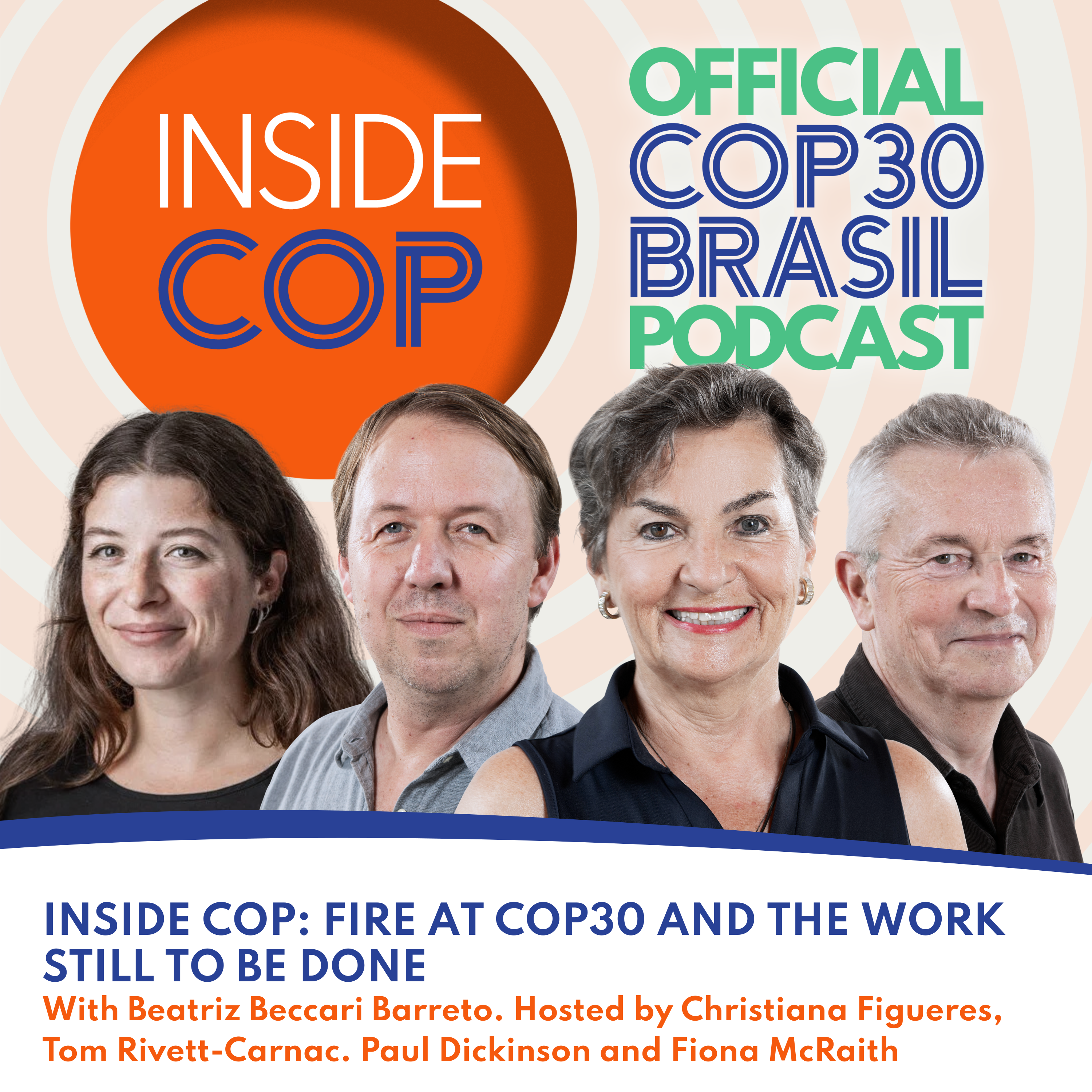
This week on Inside COP, Christiana Figueres, Tom Rivett-Carnac, Paul Dickinson and Fiona McRaith unpack what it will take to fix the world’s climate finance system, and make COP30 a turning point from pledges to real investment.
The team are joined by guest host Sue Reid, Climate Finance Advisor at Global Optimism, to demystify the landscape of public and private finance and explain how smarter systems - not just bigger sums - can unlock climate action at scale. And Avinash Persaud of the Inter-American Development Bank, outlines the major finance innovations to watch in Belém, from debt-swap facilities to the ReInvest+ initiative.
Plus, the team considers the latest NDC synthesis report, which highlights the gap between where we are and where we need to be. But do these nationally determined contributions reflect the real-world momentum already underway - or just mirror the politics of the moment?
Learn more:
🌍 Check out the official COP30 website for background and announcements
💰 Read about the Baku-to-Belém Roadmap to $1.3 Trillion
🌳 Discover the Tropical Forests Forever Facility
📈 Explore the latest NDC Synthesis Report
🎤 What do you want to hear on Inside COP? Ask us on SpeakPipe
Follow us on social media for behind the scenes moments and to watch our videos:
Instagram @outrageoptimism
LinkedIn @outrageoptimism
And we want to hear from you! What do you want to hear more of in Inside COP? Get in touch with us. Get in touch with us via this form.
Lead Producer: Ben Weaver-Hincks
Video Producer: Caitlin Hanrahan
Audio Editor: Ned Carter Miles
Exec Producer: Ellie Clifford
With thanks to Groundswell and Global Optimism.
This is a Persephonica production for Global Optimism and is part of the Acast Creator Network.
Full Transcript
Transcript generated by AI. While we aim for accuracy, errors may still occur. Please refer to the episode’s audio for the definitive version
Tom: [00:00:03] Hello and welcome to Outrage and Optimism. I'm Tom Rivett-carnac.Christiana: [00:00:06] Listeners get ready. This is going to be a long list of co-hosts. That was Tom I'm Christiana Figueres next.
Paul: [00:00:14] I'm still Paul Dickinson.
Fiona McRaith: [00:00:16] Next I'm Fiona McRaith.
Christiana: [00:00:17] And next.
Sue Reid: [00:00:19] Sue Reid.
Christiana: [00:00:20] Yay!
Paul: [00:00:21] I'm actually gonna list the eight people who are not on the podcast.
Tom: [00:00:23] Sue is here because this week on Inside Cop, we are going to demystify what's going to happen on climate finance at Cop 30. Thanks for being here. So, Christiana, I like that you've gone off script as ever within 30s. We were given strict instructions from Ben that Sue was going to be introduced in a different way.
Christiana: [00:00:40] I mean, you should know me by now that I take all instructions as excellent suggestions.
Tom: [00:00:46] Listeners, this week we are going to delve into the topic of climate finance and don't switch off, because this is actually one of the most fascinating areas of international climate politics, diplomacy that unblocks all the momentum that enables us to move forward. And that's why Sue is here.
Christiana: [00:00:59] And we promise not to make it boring.
Tom: [00:01:00] It won't be boring, it won't be confusing. And we're going to explain it to you. But before we start, we can't begin without talking directly about Hurricane Melissa, which, of course, has grown into an extremely powerful hurricane in a very short space of time in Jamaica and other parts of the Caribbean. Now, we know that these countries have been hit again and again by these devastating storms. And we also know that the record surface level temperatures of the ocean is what is driving them. So, Sue, welcome back to Outrageous Optimism. Sue is the brilliant climate finance adviser at Global Optimism. And you are here this week to help us demystify climate finance. So just to kick off with, why don't you give us a top line explainer and how do you pull apart the different types of climate finance?
Sue Reid: [00:01:44] Well, I'm delighted to join you here today. I will say I'm starting to form a little bit of a complex that maybe you all think I'm profoundly boring, profoundly financial.
Paul: [00:01:53] That's not boring. That's good.
Sue Reid: [00:01:56] Some people do hear the word finance, and especially in the context of climate negotiations. And you just see the eyes glaze over. But the truth is that finance is dynamic and complicated and profoundly complex, and an awful lot of people feel timid about finance. But the truth is, nobody knows all the answers. And so I hope more people will become braver. And climate finance, the moniker is so widely misunderstood in the context of the Paris Agreement and some formal negotiations. It has a specific meaning, typically, that is centered on public finance and the provision of finance from developed countries to developing countries. But really, climate finance is so much broader than that and encompasses both public and private finance, the flows of capital that are shifting from high carbon to clean solutions through company value chains as well as across investor portfolios. Olios. So it is really expansive and really important when you're talking about climate finance of any flavor to make sure whoever you're talking to, you're on the same page on what it is.
Tom: [00:03:09] And actually, as you speak there, I realized that it sits in the Venn diagram in the middle of three areas that have the most three letter acronyms in the world government finance, private finance, and climate action. So that might be why it's so confusing. Now we're going to get into this. Who has questions for Sue about Cop 30 and finance.
Paul: [00:03:26] Before I just this boring thing. Before we get to your question, I just want to share with the listeners that there's nothing boring about finance because there is a TikTok meme. You may know that somebody's looking for a man in finance. Trust fund 65 Blue Eyes finance trust fund 65 Blue eyes finance.
Tom: [00:03:46] Thanks, Paul. Thanks for going there. That's great.
Christiana: [00:03:48] Yeah, I know, I was so lost.
Paul: [00:03:50] You had to lose your life online. Yeah.
Tom: [00:03:53] Links in the show notes Christiana.
Christiana: [00:03:55] Yeah I think Sue, it would be helpful because there's so many different types of finance and the one that can be mobilized, accelerated at meetings such as Cop, are the pieces that respond to political decisions. If that is so, ideally, what would be a result, an outcome that we might be able to follow throughout the two weeks?
Sue Reid: [00:04:27] That's an excellent question, and I think it's fair to say there are two big things that could come out of this cop and many cops in terms of accelerating transition of finance into solutions and away from things that are worsening the climate crisis. One of those things is the signaling effect and advancing the dialogue across governments in terms of things that need to happen to unblock and unlock finance for solutions. And so I hope we'll have opportunities to talk about the so-called Baku roadmap to 1.3 trillion, which is a signature element that is being brought forward at this Cop to help signpost what are the things that need to happen to financial systems, to those large public financial institutions, to enable private finance to reach the $1.3 trillion a year additional investment that is needed for developing countries for climate finance. The other thing is that finance often follows markets. This is about changing policy so that the real economy and market shift. This is about taking the global stocktake that was adopted by every country on Earth in the climate negotiations a couple of years ago. That calls for tripling renewables, doubling efficiency, See accelerating phase out of fossil fuels, halting and reversing deforestation. Translating that into national policies to shift markets and finance will flow through the company. So those two big things signposting major reforms for unblocking finance and the policies that will transition the real economy more quickly, that will then drive in finance.
Paul: [00:06:16] So how about three categories then where money just flows? Because if there's profitable decarbonisation with an acceptable financial return, the money's just going there and no one has to do anything. It's just going to happen. Then there's a second category where there needs to be, I guess, a policy change to make it more attractive, to de-risk it in various different ways. And then there's a third category, I guess, where governments transfer money to other governments or companies in other countries as part of what was the word that you used to describe that kind of finance?
Sue Reid: [00:06:45] Ah, provision of finance from one country or set of countries to another country or set of countries.
Paul: [00:06:52] That makes it easier to understand.
Sue Reid: [00:06:53] So if you ask ten different people in the finance space how they would bucket different categories of finance, you'd probably get ten different answers. So Paul, your three buckets make sense. But there are so many different ways to slice and dice this. And one caution I have is against oversimplification. So if you just look at, say, your first point, the first bucket of areas where it's easy for finance to flow, renewables outcompeting new high carbon fossil generation and markets all around the world. Now, it's really important to also not lose sight of the fact that that's with distorted markets. We still have trillions of dollars of subsidies going to the high carbon entrenched incumbents. Think about how much easier that bucket number one would be, how much faster it would grow if we didn't have those things that are stalling progress.
Paul: [00:07:49] Can you give an example of a subsidy like that? Like that because I think it's always hard for people to imagine what they are.
Sue Reid: [00:07:53] So the IMF has put out some really helpful analyses in terms of how this breaks down. For example, tax breaks, tax breaks. Yes, yes. Well, and some areas you can see why tax incentives, tax systems are intended for example to help low income consumers have access to energy. And those systems often more often than not still flow to fossil fuels. So there are ways to rejigger these systems. So you're still enabling access to energy, but to clean energy instead of high carbon. And those systems by and large have not been fixed yet.
Fiona McRaith: [00:08:31] I wonder, Sue, if we can come back to cop, what would you say you're really looking for as signals that we are getting a bit more into the weeds on unlocking some of the mechanisms that are needed to kind of build that ladder towards the new financial system.
Sue Reid: [00:08:48] So one is the high level signaling. So this roadmap to 1.3 trillion that I mentioned, and I may sound like a broken record on the policy reforms and needing countries to take up the outcomes of the global stocktake. So the commitments that were made by every country on earth a couple of years ago at the climate talks now coming up on three years ago. And one of those is energy efficiency.
Paul: [00:09:11] First fuel, first fuel.
Sue Reid: [00:09:13] Such a no brainer, right? All these analyses that have been done for decades have shown and continue to show that energy not used is one of the most cost effective things you can do to then avoid energy waste and the related greenhouse gas emissions. And still companies and households. See, when you're investing in energy efficiency, the payback period may take a year or two years, or three years, or four years. And from household budgets to major corporate multinational corporate budgets, systems typically haven't been set up to figure out how to bear those costly upfront costs of investing in energy efficiency, even knowing that it will pay off in spades over time. So this is the kind of thing that government policies can help in terms of making it easier for businesses and homeowners to invest in energy efficiency and for that capital then to flow.
Christiana: [00:10:08] So, listeners, I'm very confident that after listening to Sue, you will understand why we chose Sue to be the anchor of this episode. So thank you very much, Sue, for stepping into that. And Sue, can we impose upon you to actually be the interviewer for our guest for this episode? Who is Avinash Persaud, who we've had on the podcast before? Avinash is now at the IDB, which is the Inter-American development Bank, one of the multilateral development banks. So without further ado, Sue, will you be willing to interview Avinash?
Sue Reid: [00:10:49] Oh, delighted to do so. It's such a pleasure.
Christiana: [00:10:52] Okay.
Sue Reid: [00:10:54] Welcome. Welcome, Avinash. Can you start with. How would you characterize the opportunity ahead at Cop 30 to shape the direction of travel for how finance works?
Avinash Persuad: [00:11:05] I think this is going to be a really consequential cop. Things are often announced with huge billion dollar tags attached to them. And then we come to the next cop and it's like the same thing gets announced because nothing happened. So I think a focus on action and implementation is very important. And we've taken the signal very clearly that they want a focus on resilience, a focus on scaling up, and a focus on forests and the alignment between nature and climate. And so we've been doing a lot of work in the past 12 months to try and develop tools that will respond and address to those things with the key thing, which is scale. Because when you go to conferences, you hear a lot of great, brilliant things. And my conclusion is human beings, we're very creative people. And there are thousands of exciting things at small scale that can't scale up. And we're at a point now where a lot of money is required for development, and we need instruments that can scale up. So I think that's the focus. And we have a couple of things we want to launch at Cop, which is focused on those things.
Sue Reid: [00:12:21] Wonderful, wonderful. Well, you pointed in particular to two things that just resonated with me and I'm sure others. Action and scale. Can you unpack that further in terms of what we need to see or expect to see at this cop on the fronts of action and scaling? Load More
Sue Reid: [00:14:37] Yeah. So Avi, what are the challenges and how can they be overcome to accelerating that, like selling off those things, the assets that already have been invested in and work to those that have the lower risk tolerance, and then freeing up all that capital for new investment. What's standing in the way of that? And how can Cup 30? I'm going to be a broken record here. What can happen at Cop 30 that can help accelerate that?
Avinash Persuad: [00:15:02] So on November 14th in Belgium we're going to be launching Reinvest Plus. So that's where we will act as a coordinator. We're bringing together the local banks who own these loans. Already, international investors who are interested in buying loans that are performing and are low risk. And we're going to be coordinating the buying of these loans and the conditionality that they're only bought on condition that the local investors, the local banks, reinvest in these new projects.
Sue Reid: [00:15:36] Fantastic. So can we come back to the other big thing that you've noted that is being teed up for announcement at Cop 30 is this multi guarantor debt swap facility and social resilience debt swaps. What does that look like on the ground when it's successful. And what do you expect. The prognosis the timeline what's coming forward in a week or two's time.
Avinash Persuad: [00:15:58] So we're going to have a launch on November the 11th, the adaptation day of Cop 30. And basically the reason why we need debt swaps. We need to release money for countries to invest in resilience. The problem is that if your climate vulnerable, you're also highly indebted, because all the previous years you've been absorbing these losses and damages from the climate with debt. And so it's right that they should invest in resilience. But where's the money coming from? So two ways to deal with that. One is to get some low cost loans to invest in resilience. And the others are debt swap in a debt swap, a triple A institution like my bank, a multilateral development bank puts its guarantee around a climate vulnerable country, and suddenly the cost of that country borrowing money collapses from, say, 10%, 9%, down to 3% or 4%. And because we know these interest savings are happening every year, we can use the money to invest in something that will make the country resilient. The limit is that the Triple-A guarantors can't do lots of them because it impacts their Triple-A rating. So what we've come up with is a way in which they can work with other non-traditional guarantors, like maybe private insurers, maybe governments. So the amount of money that was guaranteeing this debt can be expanded. And for that to happen, we have to find a way of working together. So we're coming up with a facility that really streamlines coordinates and makes it much easier to work together, and therefore to bring in non-traditional guarantors for countries to build resilience today.
Fiona McRaith: [00:17:38] Avi, it's wonderful to hear you talk. It's really fascinating. And Avi, I've been enjoying your podcast as well. I would actually love to pick up on one of the points that you mentioned in one of your episodes about the 1.3 trillion, and there's a lot of skepticism that exists about that number, and there's a healthy amount of skepticism that the Mdbs will hide behind their Triple-A ratings, and that will be the reason why they're not able, in the end, to actually fulfill these great solutions that you talk about. How would you respond to those well-intentioned skeptics?
Avinash Persuad: [00:18:12] Now, in terms of the 1.3 trillion, that's a cross-border figure. That's not all the money developing countries need for development and the social development goals and climate, nature and all those things. Even today, 80% of all disaster responses is developing countries money when all is said and done. The minute Melissa is gone, the IDB and other people will be there ready to support Jamaica 80% of the cost. They're going to be absorbing themselves. So that 1.3 trillion, I think is a conservative figure. And I think it's quite credible in terms of the number. Now the mdbs so they announced that last year they lent $120 billion to the low and middle income developing countries, and about 26 billion of that was on resilience. There's been something called the CAF reforms. You may remember the Bridgetown Initiative, when we pushed in the Bridgetown initiative, was to really have reforms to the capital adequacy framework. That's what CAF stands for, for multilateral development banks, and it has worked. The lending headroom at the development banks has increased by over $500 billion in two years. That hasn't happened in the last 20 years. So the money is there. They need to spend it well, hopefully with a focus on resilience. In the 1.3. Right. There's a 300 billion bit that's supposed to be public finance led. I think that's going to be dominated by mdbs multilateral development banks lending, low cost, long term money for resilience. Maybe they're 250 of that 300, maybe they're 225. But I think they're on target for that. They're not on target for anything more than that. And therefore, where's the other trillion going to come from is what we've been focused on this year. And that is private capital. And we need to find ways of unblocking that money from flowing to developing countries.
Fiona McRaith: [00:20:11] A couple episodes on this series we talked about, are we moving from an era of collaboration to one of competition? And something that's really struck me as you've been speaking is that this hinges upon a deep trust and collaboration. And I wonder just how are you approaching building strong relationships as you seek to build these bridges?
Avinash Persuad: [00:20:32] That's a really interesting question. And in a space dominated by sort of scientists and economists or environmental scientists. It tends to be, I think, neglected that relationships are really very critical. So we did a debt swap last year with Barbados, with the EIB, European Investment Bank, the Green Climate Fund and ourselves. And I think it's fair to say that at various points of trying to do that together, we all were thinking of walking away individually because it was so difficult working together with our different approaches, our different understanding, our different processes. But we stuck with it and it happened and it was viewed as a success. And now what we're trying to do with this multi guarantor facility is say, why don't we work those things out before we do the swap. So that was actually a little guide, a map that says when the EIB and the IDB do a debt swap together, here's how we would do it. And there's been a spirit of collaboration around that. I think cops played a really important soft power role in getting that to happen. Mdbs and all these financial institutions used to be quite competitive with each other. And Cop is said, well, what are you doing collectively? You know, what's your collective goal? What's your collective target? So that's their, uh, whether it will last? I hope so, because as we all know, in all relationships, relationships require investment.
Fiona McRaith: [00:22:00] Avi, thank you so much for joining us for dialing in. You always bring such a clarity and a breakdown of very complex things. So thank you, as always for what you're doing and hopefully see you on the ground in Brazil.
Avinash Persuad: [00:22:14] You will. Thank you very much.
Christiana: [00:22:15] Thank you Avi. What I thought was so impressive from the different examples that he was giving, is the departure from the simplistic thinking that what we need here is more and additional money. And it's not about that. It's about a smarter use of the money that is already available to go in and say, okay, this pool of money, what is it doing right now? What is its function? What is it achieving, and can we actually redesign it or redirect it so that we get 2 or 3 times the impact for the same amount of money? Redirecting and reconceiving the pools of money that are already on the table is completely brilliant.
Tom: [00:23:13] Yeah, I always have that sense talking to Avi and a few other people in the finance space around how when you drop one level down into the nuance of how the financial system works, there are these very specific intervention points that if you know where they are and how to activate them. I mean, even basic insights like oil and gas doesn't have foreign exchange because is traded in dollars, right? That little insight unlocks a whole suite of challenges that we're facing in renewables, that you can then have a plan to address the fact that all of these assets are being held domestically, and you can get a secondary market for offloading them and recycle the capital back into more solutions, like leave me alone for a thousand years. I'd never come up with them because I don't know how the finance system works well enough, but when you have that forensic insight, you can just pinpoint these systemic solutions and unlock massive opportunities that flooding the world with cash wouldn't deliver. So I completely agree exactly.
Sue Reid: [00:24:02] Indeed, my good friend, the brilliant Sean Kidney, who runs the Climate Bonds initiative, he likes to say we don't need more money to address the climate crisis. The world, as he puts it, is awash in capital. What we need is it to be directed toward the things that foster as opposed to undermine prosperity for everyone?
Tom: [00:24:21] Yeah. So, Christiana, earlier this week you had a conversation with Ana Toni, the CEO of the Cop, about her reflections and thoughts and feelings a week ahead of everyone beginning to arrive in Brazil. Let's have a listen to that.
Christiana: [00:24:35] Well, it is a few days before the cop starts and the high level segment. We would just love to know. Ana, what is top of mind for you, where you feel that things are going really well and there's no crystal ball. Obviously there's never any guarantee in any cop, always full of surprises, but just your top of the line message for listeners at this point.
Ana Toni: [00:25:02] It's really nice to have more than 180 countries already with their credentials saying telling us that they will be present. But most of all, I wanted to say that despite a lot of uncertainties of the geopolitics that you, Cristina, has also been discussing a lot in your program. We know when a regime is solid. Remember, we start the year with the US saying that it was going to leave the Paris Agreement. All of us have been really afraid that other countries are going to follow through the same path. It hasn't happened. We can see many NDCs coming up. Obviously we wanted to have many more numbers. But after the summit in New York, more than 100 NDCs, we believe is going to be present before the Cop. It shows that the entire cycle of the Paris Agreement is working and is working well. The direction has been given and everybody is with us. To make Cop 30 a step forward. In terms of the combat on climate change, I think the big challenge that all of us have now is how to accelerate the changes that has been started. And we are hoping that Cop 30, with the action agenda that has been designed with the involvement of civil society, private sector and especially subnational governments, will be able to give the determination of acceleration that we so much needed at Cop 13.
Christiana: [00:26:37] You spoke about geopolitics and the old energy system based on fossil fuels kept most nations and about three quarters of the world's population dependent on having to import fossil fuels, mostly from volatile and unpredictable countries. Contrary to that, the new energy system empowers every country to harness their own wind, their sun. So geopolitics is shifting toward the new energy system in a way that is not dependent on political cycles. And I think that that is really important to understand because otherwise we keep ourselves in this mental prison of geopolitics being determined by political elections and political cycles.
Ana Toni: [00:27:39] Yeah, you're absolutely right. And I think there are layers of geopolitics where we see the big political geopolitics in terms of wars and trade wars is one. But the climate geopolitics is moving and is moving fast.
Christiana: [00:27:55] Exactly.
Ana Toni: [00:27:56] Not only on energy, on nature, on the use of resources. And these new geopolitics is not having enough attention to that because the political geopolitics is taking all the headlines. But when we have time to bring to the surface what's happening in these climate geopolitics, I think we will see so much innovation. And that's exactly the type of debate we wanted to have at Cop 30.
Christiana: [00:28:22] I love that differentiation between the political geopolitics and climate geopolitics. I wonder if US citizens who are feeling increasingly concerned about what they're seeing coming out of their administration, would actually feel a sense of certain relief that there are big picture decisions being taken at Cop 30.
Ana Toni: [00:28:46] The message that we have to the US citizens is that first, they will be extremely welcome to our Cop. There are many subnational governments, many private sector groups that wanted to be involved. They have been involved in New York. Climate week was amazing how many meetings we had more than a thousand. The energy that's happening there is just amazing. It will be very much welcome at Cop 30. We know they're moving. We know they're doing things. And it will be an opportunity also for them to show that we have global solidarity to the ones that are fighting climate change inside and outside the US.
Christiana: [00:29:26] Absolutely. And just to give a data point to your message there. 89% of world population wants their governments to do something responsible on climate change. Cop 30 will be a very good contribution to that.
Ana Toni: [00:29:41] Absolutely. I think Cop 30 starts a new era of cops because it took us so long to act in this direction. Now that everybody's with us, we need to ensure that we can make the change we need to make with the speed that is required.
Paul: [00:30:03] First of all, it's just lovely. You know, we all kind of freak out about Donald Trump. I freak out about Donald Trump and Paris and blah, blah, blah. She says, you know, despite the USA, no other countries have left the Paris Agreement and geopolitics are moving fast. Us citizens are welcome at the Cop. She says it's an opportunity to show global solidarity.
Sue Reid: [00:30:19] Yeah. I would just add, you know, it's important to keep in mind that the United States is not one homogenous entity by far. And as we've seen in the past, when political leadership has diverged from driving climate solutions, to put it mildly, individual geographies within the United States like California, what would it be? The fifth or sixth largest country on Earth if it were its own country? Progress is still going forward at pace there and across the entirety of the United States in pockets and in broad geographies. And we expect substantial representation at the Cop at the subnational level. So states, cities, companies, investors, civil society still to be very, very actively engaged, driving forward that essential momentum.
Christiana: [00:31:08] Tom, we heard from our good friend Yasmin, who now sits on Capitol Hill, that there is an impressive delegation of Congress people going down to Berlin. Did she say 17 members of Congress?
Tom: [00:31:23] Yeah. 16, I believe. Yeah.
Christiana: [00:31:24] I mean, that's brilliant to the point that US citizens and political leaders are very much welcome. Gavin Newsom will be there, as we know, and we'll be having several events with him, plus leaders from cities, from corporations. So again, we have this repeat performance of the real economy and the real leadership in the United States, just like they had to the first term of Trump in office just circumvent his craziness and turn up because they're still in.
Tom: [00:31:59] Yeah, I agree with that completely. It's very impressive. And there's also something else that just underlines the scale of the challenge that we will face here. I did a briefing for a global news organization this week that everyone will have heard of, that was chaired by their climate reporter, and I started it off by saying, this is a different cop. It's about participation. It's about implementation. It's about actions, about momentum. It's about everyone in society. And the first question back to me from their climate reporter was, aren't you just saying that because it's going to fail and that at the very end of the last minute, you won't have a jeopardy moment that will lead us to textual outcomes that mean we're moving forward. And I just thought it spoke to the narrative that still exists in the media, that what we're describing and what we're trying to support Anna in creating, which is a new type of cop, is not how the media are still understanding.
Christiana: [00:32:47] And what was your response, Tom?
Tom: [00:32:48] I just said that is a complete misunderstanding of what I'm trying to present, and I'm not trying to conceal a failure. I'm trying to help you understand that we're moving to a different mode around what progress looks like on climate, but I would not come out of there convinced that they came with me in that narrative. And I think particularly of that journalist, what's in that person's head is still success. And failure is the jeopardy at 3:00 in the morning on the last night.
Christiana: [00:33:18] I just think it's very interesting that when you take this to a human level, the equivalent of the human level is nine months of pregnancy, where everybody is completely focused on is the baby going to be born? How is it going to be born? Is it going to be healthy? Is the mother going to be healthy? What are we going to do? And everybody is focused on that for nine months. Obsessed. Then the baby is born and it is healthy. Why do ten years later we still ask, is there a baby going to be born ten years later? We should be going like this. Child is not just walking, it's beginning to run. Do not put it back into the mother's uterus.
Paul: [00:34:02] This is not the reincarnation cop. It's very well made point, Christiana. And secondarily, we are the media. Just remember, this is inside cop. We're all in Belgium with media passes. So goodbye legacy media. Hello inside cop.
Tom: [00:34:15] Now indices of course, are the nationally determined And contributions that countries make, that commit that country to a set of activities to reduce their emissions over a five year period and do a variety of other things. They came out of the Paris Agreement. The Paris Agreement is worth revisiting, has an innovative structure. It has a long term goal to get our emissions to net zero by the middle of the century. And we get there through a series of five yearly goals. So it's like me saying I want to lose £20 in weight by the end of this year. For the first month, I'm just going to try and lose £1. That's my first period of nationally determined contribution. I get up off the couch, I start running a bit. I eat a bit healthier. At the end of that month, I feel a little better. So the next month's commitment can be to lose £2. And as we go on through the year, I can make more and more ambitious targets for my monthly goals that will ultimately get me to losing £20 by the end of the year. Now, the synthesis report of NDCs came out on Tuesday. It showed that 60 odd countries have released their NDCs were a long way from where we need to be. Now that, of course, reflects the political reality of today. It does not reflect the scale of implementation happening around the world.
Paul: [00:35:22] I mean, these questions of the NDCs is fascinating. I've been thinking so hard. What are they? It's some sort of statement where you are being judged by your peers, and you're looking at what others are saying and doing, and it correlates also to the capabilities of the technology at the time. And it also attends to some degrees of geopolitical winds blowing this way and that. So it's a very complicated thing. It's a kind of a manifesto for a nation.
Tom: [00:35:47] Yes. And it's also worth remembering that 130 countries have not released their NDCs. What we have in the synthesis report is that by 2035, if fully implemented, our emissions would only go down 10%. There's nothing like enough, right? So the narrative that we are likely to see over the course of the next couple of weeks is likely to be quite a defeated narrative, that NDCs were the tool by which we manage this, and NDCs are not up to the task if we want the narrative to actually be. The world is moving forward. The economics have shifted, the opportunity is enormous, and we're running and taking this. We're going to have to help our friends and journalists and others around the world to see this in a different way.
Christiana : [00:36:28] That's what we're doing.
Tom: [00:36:29] This is the critical moment, and the next two weeks are going to be so important for that opinion shape. Okay. So I think that brings us to the end of our episode. I know we haven't delved as deeply into the NDC synthesis report, but I also feel completely confident that we will be back on that topic in the coming days.
Paul: [00:36:45] Ndc is a critical and critical part of the infrastructure for the future and emerging.
Sue Reid: [00:36:49] Can I out of turn off for one parting thought please? Because it wasn't centered enough? I think in my own thoughts earlier, the Tropical Forest Forever facility, I can't help but flag as a real beacon of innovation and hope and progress. It aims to bring in $25 billion of sponsor contributions from countries and from philanthropies, and to drive in $100 billion in private capital to create investments that will deliver returns for incentives for preserving forests that are across 74 different countries and supporting indigenous peoples and local communities. And yes, it's a blended finance vehicle of massive scale.
Paul: [00:37:33] Blended finance, blended finance.
Sue Reid: [00:37:36] So this is when public finance and private finance come together. There are certain things that private finance is not particularly well situated to be invested in. And a public finance institution can come in and absorb some of that risk. So you pool both public and private resources together to meet the investment need. That's what blended finance is all about. So this is the kind of thing that works that we need out there to scale and will help us cut past some of this malaise in terms of insufficient ambition in various spheres that we've just been touching on.
Christiana: [00:38:14] Such a good point, Sue. Such a good point. And of course, we don't know if this is going to get off, but there is a lot of efforts being done to get this off the ground to just pull those pieces of the conversation together. None of the NDCs reflect what the T triple F could actually do to improve their NDCs in the land use sector. So a very good point in case in just taking the NDC report and drawing a straight line, assuming that that's going to be a straight line from here until 2050 or until 2080 or until 2100 just doesn't reflect reality. We will continue to change. We will continue to improve. So let us not assume that we have a straight line from what we're seeing now to 250 or to two 100.
Tom: [00:39:03] Thanks for joining us this week.
Christiana: [00:39:04] Bye.
Paul: [00:39:05] Great to be with you. See you all next week.
Christiana: [00:39:07] Bye bye.