









325 : Inside COP: The COP30 President Speaks, the Summit Begins
On Day One of COP30 we sit down with Ambassador André Corrêa do Lago, Brazil’s COP30 President and ask, can he steer a divided world toward unity?



Related Episodes
.png)
.png)
.png)
.png)
.png)
.png)
.png)
.png)
.png)
.png)

.png)
.png)
About this episode
COP30 is here!
Day one dawns in the Amazon, and all eyes are on the host nation - and on the man tasked with steering the talks.
On the eve of what could be the most consequential COP since Paris, Christiana Figueres and Tom Rivett-Carnac sat down with Ambassador André Corrêa do Lago, Brazil’s COP30 President, for an inside look at his priorities: the tone he hopes to set and the outcomes he hopes to see for this pivotal summit.
How does he view the difference between negotiation and implementation? How can leaders sustain confidence in progress when some countries aren’t even in the room? And what will it take to restore faith that this process can still deliver?
The science is unsparing: the 1.5°C limit is no longer a distant prospect but a fast-approaching threshold. Meanwhile, the geopolitical framework on which multilateral cooperation depends is under strain. Against this backdrop, Ambassador Corrêa do Lago faces an unenviable task: to steer a divided world toward unity, and to turn ambition into action on the banks of the Amazon. Can he do it?
Learn more:
Listen to our episode, Inside COP: How to Build a COP
🌍 Check out the official COP website for background and announcements
🎤 What do you want to hear on Inside COP? Ask us on SpeakPipe or on our socials where you can also see more behind the scenes moments and to watch our videos:
Instagram @outrageoptimism
LinkedIn @outrageoptimism
Or via this form.
Producer: Ben Weaver-Hincks
Edited by: Miles Martignoni
Video Producer: Caitlin Hanrahan
Exec Producer: Ellie Clifford
With thanks to Groundswell and Global Optimism.
This is a Persephonica production for Global Optimism and is part of the Acast Creator Network.
Full Transcript
Transcript generated by AI. While we aim for accuracy, errors may still occur. Please refer to the episode’s audio for the definitive version
Tom Rivett-Carnac: [00:00:03] Hello and welcome to Inside Cop from Outrage and Optimism. I'm Tom Rivett-carnac.Christiana Figueres: [00:00:07] I'm Christiana Figueres, and listeners, this really is going to be an episode about the inside of the cop.
Tom Rivett-Carnac: [00:00:14] Cop 30 has begun. We're going to bring you some analysis and we speak to Cop President Andre Correa de Lago. Thanks for being here. So first thing to say, of course, is that the BLM climate summit ended last week as the heads of state left. There's some interesting outcomes from here. Brazil's President Lula, of course, was a really important participant and he set a really high ambition tone. He called this a cop of truth and anchored it in the concept of a mutual multilateral climate. Action was, of course, really defended with leaders talking about the progress since Paris. And there were some encouraging signs on the intention of the cop to follow up on things like fossil fuel transition commitments around forest protection. A lot of endorsement of the Tropical Forest Forever facility. 53 countries together. Also as we talked about previously with some capitalization. But however, there was also a lot of silence. We didn't really hear very much on finance, much on adaptation, much on loss and damage. There was hardly anything on the nationally determined contributions. So a bit of a mixed picture with some real political momentum, but a lot of questions remaining for the Cop.
President Lula: [00:01:29] Immobilization. Recursos necesarios para objetivos para avanzar.
Tom Rivett-Carnac: [00:01:36] So by the time you're listening to this, the cop will be up and running, and we want to do a bit of a scene setter and help people understand what's happening here, why it's important, what they're likely to see. So what would you like to say to kick us off?
Christiana Figueres: [00:01:48] Well, first, maybe. Why on earth are we in Brazil? Is that a good place to start?
Tom Rivett-Carnac: [00:01:54] It's a question we've been asking ourselves, isn't it?
Christiana Figueres: [00:01:57] So maybe just to, um, understand that the Cop presidency, which is a political role and we will get into that, rotates from one of the five UN regions to the next, and it rotates in alphabetical order. So the Africans first, then the Asia Pacific states, then Eastern Europe, then Latin America and the Caribbean, um, and then the last one is sort of a hodgepodge of, uh, European and other countries, which is a very weird watch, a hodgepodge of everybody else who's not included in the original five.
Tom Rivett-Carnac: [00:02:38] Just because you say Latin America, in the Caribbean and a more enthusiastic voice doesn't make it the most important.
Christiana Figueres: [00:02:43] Of course it is. I mean, having to listen to this podcast before, obviously. So we are now in the most important, significant, compelling region of the United Nations, all five regions, and it was the turn of Latin America and Caribbean to choose which of the member countries would host the cup. And after much discussion, it was decided that it would be Brazil. So that is why we're in Brazil. The next question is why are we in Belém? Because we're not in Rio. We're not in Sao Paulo. We're not in Brasilia, which is, uh, the the capital. Why are we in?
Tom Rivett-Carnac: [00:03:25] Brazil, of course, has hosted environmental conferences before the first in 1982 summit Rio plus ten. Always been in Rio.
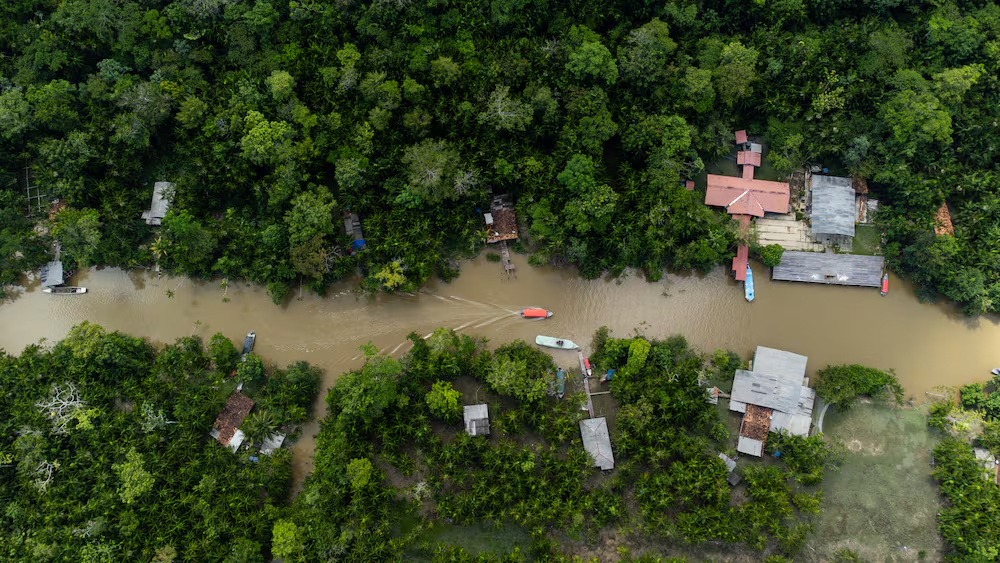
Christiana Figueres: [00:03:31] Always in Rio. Because that is sort of, let's put it, the international stage capital of Brazil. But not this time. The president of Brazil, President Lula, chose to host this international conference in Belém, which is right in the middle of the Amazon. And those who are here will have already seen the Amazon flowing basically right in front of wherever they are staying. That was a political choice that he made first for internal domestic politics. And please do refer to previous podcasts. Which number is it where we went into that.
Tom Rivett-Carnac: [00:04:13] Ben will will help us with that in the show notes.
Christiana Figueres: [00:04:15] Okay. In the show notes, we have a magnificent episode that explains the domestic agenda around the choice of Berlin, but also because Brazil, being one of the most vastly forested countries of the world, really wanted to make a point about the importance of forests, which is a new point that Brazil is making. And we will hear in the interview that Brazil has actually had a very interesting turn around about this issue, but they are currently definitely one of the world's leaders on protecting forests. On stopping deforestation and on the importance of forests for addressing climate change. So that's the reason why we're in Brazil. That's the reason why we're in Belém.
Tom Rivett-Carnac: [00:05:04] My little fact that I discovered about this part of the world, the scale is so vast. There is an island opposite us that we look at while we're in Belem, an island in the middle of the Amazon. That island is the size of Switzerland.
Christiana Figueres: [00:05:19] The size of Switzerland.
Tom Rivett-Carnac: [00:05:22] So just try and get your mind around that. An island in a river the size of Switzerland. The scale here is astonishing. And the forest is everywhere.
Christiana Figueres: [00:05:31] And the river, right? We we think of a river as though, you know, we were in any other country, and you could see to the other side of the river here you stand at the riverfront and you think you're in front of a lake or the ocean, a huge lake or the ocean, because it is absolutely so huge.
Tom Rivett-Carnac: [00:05:48] So in a minute, Christiana, we are going to talk to our guest. And really, we could not have a better guest to open our Inside Cop series. I mean, the cops, as you say, rotate from country to country, from region to region. And every time a country is selected, one individual is appointed to be the president of that cop.
Christiana Figueres: [00:06:06] And it is the president of the country that selects the president of the Cup.
Tom Rivett-Carnac: [00:06:10] And why don't you just tell us, first of all, why that role is important?
Christiana Figueres: [00:06:14] That role is important because that person holds the political baton of that single meeting. So that is the responsibility of the Cop president to work for the 12 months prior to the Cop throughout the whole year, to prepare the political ground, to talk to every single country ahead of time, to understand what their interests, what their needs are, above all, to understand what their quote unquote redlines are and what are red lines. Those are things that you already know that they cannot agree to. No matter what, it is really important for a president to understand both what is the potential common ground that he can find, but also what is absolutely outside the scope of any agreement.
Tom Rivett-Carnac: [00:07:10] So this person, I have to say, because we interviewed him this afternoon, is a supreme diplomat, like an absolute master of how you bring people together. And I think actually, the interview that we'll go to in a sec is a masterclass in how do you bring people together around a diplomatic outcome that, by definition, is incredibly complicated.
Christiana Figueres: [00:07:28] Another fun differentiation, Tom, for listeners, is that there are diplomats who are trained in representing their country from a bilateral perspective vis a vis another country, and they're usually sent to post.
Tom Rivett-Carnac: [00:07:43] Bilateral is two countries.
Christiana Figueres: [00:07:45] Sent to post. You know, that where they engage in the relationship between their home country and the country that they're in, and most diplomats are trained like that. There is an additional training and experience for those who will do multilateral for those who represent their country to, for example, the United Nations or to the World Trade Organization or to any institution where all countries of the world are represented. That is an additional expertise and training that you have to have. And André de Lago has been a multilateral diplomat, of course, a bilateral also, but a multilateral diplomat for many, many years. So we are in very good hands. And as he says in this interview, he's the first negotiator, climate negotiator that is a cop president. So honestly, he knows the tricks of the trade.
Tom Rivett-Carnac: [00:08:43] Absolutely. So and been around, as you say, for a long time now just before we go to that conversation. What is he balancing at this cop like? You know, we talked earlier about and you and I have talked for years about the outcomes of these things need to be properly balanced between the different considerations of all of the different players. This is a different kind of cop. It's ten years since Paris. We are talking much more about what's happening on the ground. The multilateral deals have been there in the past, but just do us a tiny little scene setter of what is in front of this man over the next two weeks.
Christiana Figueres: [00:09:16] It's not an easy job that ambassador de Lago has for several reasons. One is that he is not dealing with a binary situation of either you succeed or you don't. We had that ten years ago in Paris, where either we adopted a an ambitious agreement or we didn't. And when you don't, you have the result that you had in Copenhagen, of course, in 2019. So this is not a binary yes or no situation where you either have a legal agreement or you don't. This is much more difficult. Or at least the difficulty is a different one, because he needs to show that ten years after Paris, there is progress on all fronts on the implementation, the execution, the delivery of the Paris Agreement. But that is not a specific outcome that he can show he needs to have parties. Countries recognize everything that is going on, recognize the different fronts of progress, and then be able to wrap it up in some political outcome. That would not confuse people, because there are so many strands of progress that if you begin to make a long list, everybody gets lost. So he needs to wrap that up into some package that shows that the progress is everywhere, but makes it easily communicable. That progress is actually occurring. He needs to cement the public perception that the momentum on climate action is underway, that it is unstoppable, that it is irreversible, certainly behind schedule, but it is irreversible. So how does he do that when what he has to play with is actually a lot of information, a lot of proof points that are really difficult to wrap up in a single outcome.
Tom Rivett-Carnac: [00:11:27] Absolutely. It's such an interesting challenge. So. So let's go to this conversation. I mean, you know, listeners may not have heard of Andre Correa do Lago before, but I would really encourage you to like just just really sit back and absorb this. This is a a masterclass from one of the best diplomats in the world. On how do you have a strategy towards a multilateral outcome? And we should just say, before we go to this, the blue zone, as it's called, the cop itself was closed today because they have to do a security sweep before it turns into UN territory, which will happen tomorrow. So we were sitting in this cafeteria and it was kind of amazing. All of these different heads of delegation, heads of UN institutions, Simon Steele, who now has the job that Christiana used to have running the UNF, triple C, all of these people were like huddling and running meetings in the background. And we were sort of just trying to get on with our podcast in one corner of the room. So that does, however, lead to a bit of noise. So there might be some background interference in this interview, but let's now go to our interview with Ambassador Correa do Lago.
Christiana Figueres: [00:12:29] Ambassador Andrew Lago. First of all, how delightful to see you.
André Corrêa do Lago: [00:12:33] Wonderful to see you.
Christiana Figueres: [00:12:35] Many, many years ago, we were actually working side by side. And here we are now serving as your official podcast team.
André Corrêa do Lago: [00:12:43] Isn't it fantastic?
Christiana Figueres: [00:12:44] It is fantastic. Ambassador de Lago, I've known you for so many years, but this is the first time that I encounter you as president of the Cup. That's pretty unique. Opportunity. So what do you feel is the unique role of the Cup president, and how are you stepping into that role?
André Corrêa do Lago: [00:13:06] Yeah, I think that like in so many things with the U.N., the personality of the person that has a special role can make a difference. Sometimes it's not welcome, as you know. Very well know, but I know the person. No person should not have any opinion about any of that. So let's say that the essential word is that I have to be impartial. But it's quite interesting because, um, a friend of mine showed me and I had never looked at it. Now, yes, the difference between impartial and neutral. It's completely different. So I cannot be neutral. But I can be impartial. So I'll try to balance that, because I think that it is important to have the personality. And as you know, I have a very strange situation also as president of Cop is that someone pointed out that I am the first negotiator that becomes president of Cop. So maybe I know negotiators better than other presidents of cops. And I also know the process because, Christiane, if I haven't understood until now, I'm. Load More
André Corrêa do Lago: [00:14:32] Understood, there is no.
Christiana Figueres: [00:14:33] Hope.
André Corrêa do Lago: [00:14:34] So. So maybe I can try to use this in a positive way to at the same time, strengthen the best part of the process and of the Paris Accord and the Unfcc, and try to move some things that, as a negotiator, I've always known, is something complicated about the process. Yeah. So let's see how how I go.
Christiana Figueres: [00:15:04] It's a very important distinction. I've always thought about it as the need to be open to all positions, all interests, all needs, but not be indifferent to outcome because the responsibility. Shared responsibility of the Cop presidency and the Secretariat is to continue to build on previous cops, one step at a time in the process of addressing climate change. So neither of you, neither you nor Simon can be indifferent to outcome. But both of you have to be very open to all positions, needs and interests. So, um, so so let's get into some topics first. Much has been reported in the press about roadmaps, about a roadmap, perhaps in the energy sector, perhaps a roadmap in the nature solutions sector. And I wanted to give you the opportunity to lay out for your listeners, what do you understand as a roadmap, and how are you planning on bringing it together?
André Corrêa do Lago: [00:16:10] Hmm.
Christiana Figueres: [00:16:11] That's the easy question.
André Corrêa do Lago: [00:16:12] That's the easy one. Oh that's great. That's great. So we just published a roadmap. The president of Cop 29 and myself on Baku 2,000,000,001.3 trillion objective. And it was a very interesting exercise. But you have to see where it was born. I mean, it came in the decision of the. Those horrible initiatives. And, um, that was a package for the finance. For finance in Baku. So it came with 300 billion a year. But since most people think we need more, we also ask for a roadmap on how can we get to 1.3. So is that a formula that can be repeated for other big issues? That's a very interesting question.
Christiana Figueres: [00:17:10] What issues do you have in mind there? Me I'm just going to already tell you one issue I think that could do very well with the roadmap is how do we continue a process that has already started, but that needs to be completed of getting beyond fossil fuels. Another process that would very much benefit from such a process is how are we going to catch up in the land based solutions? Catch up with progress in the energy sector that has been ongoing land, everything to do with land, whether it's deforestation, whether it's restoration of degraded lands, um, is very far behind and you have ensured that that is going to be front and centre of this cop together with indigenous rights. So are those topics also ripe for a roadmap?
André Corrêa do Lago: [00:18:06] Well, yes, I think that that's what people expect from the process. Now, is that what the parties want from the process? That's another question. And I believe, Christiana, that what what we have somehow achieved during the mobilization period of this cop is for people to understand, like we understood by preparing Cop 30, that there is a different logic that we need to establish a different logic between negotiation and implementation. So negotiation is somehow creating international law even more after the decision of the International Court of Justice. So countries are very careful. Countries are generally all of them very conservative.
Christiana Figueres: [00:19:01] Cautious.
André Corrêa do Lago: [00:19:01] Cautious because they have lots of pressure from the sectors in each country that may lose in that transition. And all countries have sectors that are going to lose in that transition. So countries end up being lobbied at home by the sectors that fear most, not by the sectors that think this is an amazing agenda and we're going to do amazing things in this new economy. So if you start from that logic of the spirit behind negotiation, you see how different implementation is, because implementation is, first of all, a decision of the country. You can choose one path or another because we have all agreed on the transition. But in fact it's many transitions. Each one will have his own transition. So I think that the first element to answer your question is this differentiation between negotiation and implementation that I believe we have advanced in the months and this last month. Do you agree?
Christiana Figueres: [00:20:13] Yes, I do agree.
André Corrêa do Lago: [00:20:14] I'm so happy when you agree with me.
Christiana Figueres: [00:20:18] I do agree that that there is a different logic. There are different parties that are acting in that space because the one is definitely in the hands of national governments. The other space is in the hands of all other stakeholders. Nonetheless, you as the Cop president are responsible for the political magic.
André Corrêa do Lago: [00:20:41] Hmm hmm.
André Corrêa do Lago: [00:20:44] That's a big word.
Christiana Figueres: [00:20:45] That's a big word. And then, if I may, you have a similar challenge on the other side with everything to do with implementation, because that is, in fact, even more disparate than the first package. That is all sectors, all countries, all kinds of stakeholders. Fortunately, and to our delight, taking many initiatives and decarbonizing and doing so exponentially. And all of that is great news. But that's very difficult to communicate because it is so disparate. So I'm wondering if you have another little magical political wand to bring all of that together.
Tom Rivett-Carnac: [00:21:25] That's up to two magic words. Yeah. Now we have.
Christiana Figueres: [00:21:27] Two magical wands.
Tom Rivett-Carnac: [00:21:28] But I do have a third one.
André Corrêa do Lago: [00:21:30] Was not enough.
Tom Rivett-Carnac: [00:21:31] Yeah, one is not enough.
André Corrêa do Lago: [00:21:32] Yeah.
Christiana Figueres: [00:21:33] So how do you bring all of that together? How do we convince everyone? And then because you have a third wand hidden somewhere, how do you put both of those two packages into the overall cop message, i.e. what is the headline that you want to see in all newspapers the day the cop finishes?
André Corrêa do Lago: [00:21:54] Um, yes. The questions are getting more difficult. Uh, I really don't know, but I, I think that someone that is completely outside of the process told me something that I liked very much. She told me, you know, people have to perceive that there is progress in the many dimensions.
Christiana Figueres: [00:22:22] Exactly.
André Corrêa do Lago: [00:22:23] So obviously the same person. I mean, the climate change today touches so many people, from businesses to science to, uh, to governments to local governments, etc. you cannot expect that one answer is going to be considered a good answer by all these actors.
Tom Rivett-Carnac: [00:22:40] Correct?
André Corrêa do Lago: [00:22:41] Yeah. When we were slightly young, we believed that progress would be constant and that the advances that happen in the rights of women, uh, rights of indigenous people, minorities, all these things, we thought now that we got it. This is not going to go backwards. Things are going backwards today. So the concept of progress, I think, for the younger generation is much stronger than for us because for us it was almost a given. You know, that progress is happening and it's true. I think that not only people are expecting different things from the cop, but also many people don't know what to expect from the cop because many people have lost faith in this whole process. Yes, I think that what we must absolutely avoid, I think, is clear to me. No, I think that we have to show that multilateralism works. We have to show that science is telling us the truth. We have to say that the economy has answers to most of the challenges, and we have examples of countries doing the right thing, companies doing the right thing, communities doing.
Christiana Figueres: [00:23:59] Absolutely.
André Corrêa do Lago: [00:23:59] Yeah. So how do we package this? I agree is not obvious. Then you have the key issue regarding what is negotiated among countries is that you depend on countries. You depend on countries. But I believe that none of the countries that are that are coming want To multilateralism to be worse?
Tom Rivett-Carnac: [00:24:24] Definitely.
Christiana Figueres: [00:24:25] Now, you were very careful to say that all of the countries who are coming do not want to see multilateralism weakened.
Tom Rivett-Carnac: [00:24:33] Yeah.
Christiana Figueres: [00:24:34] All of the countries who are coming.
Tom Rivett-Carnac: [00:24:36] Yeah.
Christiana Figueres: [00:24:36] There is one country who is not coming.
André Corrêa do Lago: [00:24:39] Yeah, apparently we have not.
Tom Rivett-Carnac: [00:24:41] Apparently. Yeah.
André Corrêa do Lago: [00:24:42] So we have strong indications. Strong diplomats?
Tom Rivett-Carnac: [00:24:46] Exactly.
Christiana Figueres: [00:24:47] So Tom has a question about that.
Tom Rivett-Carnac: [00:24:49] I don't really want to interrupt this because it's such a lovely conversation.But I will. Okay. So, um. Ambassador.
Tom Rivett-Carnac: [00:24:55] Hi. Um, I suppose this question, unlike Christiana's question of the day after the call, is how will this cop be remembered in five years? Because they're not all remembered in five years, but some of them are. And the fact that the United States has abdicated global responsibility to the point where they're not even coming to this cop, Leaves an opportunity as well as a risk. And I wonder whether or what you would say if you flip it from. It's very bad. They're not coming to the opportunity that can be grasped by other countries. Do you think that this cop will be remembered as the moment when the BRICs countries, big, middle income, emerging countries, stepped out into global leadership on this critical issue and showed the way for the world to get back on track in the absence of a space that the United Nations, the United States, vacated.
André Corrêa do Lago: [00:25:55] Yeah, that is something that we've been thinking a lot in the last year and a half in Brazil. First, when we were presiding the G20, then when we were presiding BRICs, and now in the preparation of Cop 30. First of all, leadership cannot be self-proclaimed. It's the other people that have to say that you are a leader. So you cannot come and say, hi, I'm the new leader. No, you have to be recognized as such. Second is that I think that there are many emerging countries and many countries also in Europe, etc., that can be considered leaders, but they are not overwhelming leaders. They are leaders in a sector. They are leaders in a few sectors. They are leaders because they prove some extremely important points in the fight against climate change. But there is not a country that wants to appear as the one that has all the answers. So if you accept that the new leadership will come from some actions in some sectors, I think that this is already happening. Uh.
Christiana Figueres: [00:27:11] Definitely in China, for sure.
André Corrêa do Lago: [00:27:13] That's it.
Tom Rivett-Carnac: [00:27:14] China no doubt.
André Corrêa do Lago: [00:27:15] You choose what you want to talk about because it's amazing. So they show that in their GDP, a significant part of their GDP growth is thanks to the areas that are linked to renewables, etc., technologies that are more sustainable, etc. then in electric cars, we don't need to say or solar or batteries, all these things, they are absolutely amazing and people underestimate one dimension. For instance, when we all say as developing countries, Christian and I, and we say that we need support and we think immediately of financial support. China has given the most amazing support to the world by reducing 90% of the cost of solar, of solar energy.
Christiana Figueres: [00:28:08] Allowing so many other countries to reduce their emissions.
André Corrêa do Lago: [00:28:11] Absolutely. So China, by reducing the price and the price of other. So they are bringing solutions without the what you would call classic cooperation. But indirectly it is a much more effective.
Tom Rivett-Carnac: [00:28:27] Much more.
André Corrêa do Lago: [00:28:28] Cooperation. So I think that Brazil can also claim some of its experiences. And I think that this cop, for instance, is a cop and Christian and Jew. You remember, Brazil was very reluctant to talk about forests because we knew that forests. She's smiling.
Tom Rivett-Carnac: [00:28:49] Because.
André Corrêa do Lago: [00:28:50] Her life.
Tom Rivett-Carnac: [00:28:51] Was difficult. Her life was difficult because.
André Corrêa do Lago: [00:28:54] Of Brazilian diplomats. But the. But why? Because again, the countries are conservative in things that they believe they don't control. And the truth is that we didn't know how to have an economic logic that would stop deforestation. So how can you commit your country to do something that you don't know how to do? So Brazil was very conservative until we have a civil society and a business society and an academia that said, come on, let's find the solutions. We have the biggest forests in the world. If we don't find a solution, nobody is going to find a solution. So fortunately, this was translated in Brazil's positions in international negotiations. When we started to see. You noticed.
Tom Rivett-Carnac: [00:29:48] Yes, I did notice. Yeah. Yeah, yeah.
André Corrêa do Lago: [00:29:51] So now we got carried away.
Tom Rivett-Carnac: [00:29:54] Yeah. Thank heavens for that.
André Corrêa do Lago: [00:30:01] So I think that this is the kind of leadership also that is somehow unexpected. But, uh, we, we see that things that come from the emerging countries, there are solutions that can be adopted by other emerging countries. It is a completely different kind of leadership than the traditional leadership of financial support for something that the donor country thinks is a good idea.
Tom Rivett-Carnac: [00:30:32] Yes. Yeah.
Christiana Figueres: [00:30:33] Yes.
Tom Rivett-Carnac: [00:30:34] I mean, that kind of leadership, that innovation that can spread between countries without any sense of engagement, to try to engineer an outcome is the kind of leadership that can spread and cascade. So so that moment is very important for the quality and the scale of the solutions. Do you think we're at that point now?
André Corrêa do Lago: [00:30:53] I think we are at that point, and maybe the absence of the United States and a considerable reluctance from some European actors may help these ideas, these solutions to emerge.
Tom Rivett-Carnac: [00:31:12] Right, right.
Tom Rivett-Carnac: [00:31:13] Yeah, yeah. Ambassador, we are sitting here in the corner of a dining room in a hotel next to the cop. I think everyone's going to come and have dinner now, so we better wrap up. So thank you so much for your time.
André Corrêa do Lago: [00:31:23] Thank you very much. We are already in popular.
Tom Rivett-Carnac: [00:31:28] Let's not make ourselves more unpopular.
Christiana Figueres: [00:31:32] Tom, don't you think that was interesting? That when I asked him, what is the headline that he wants to see when the cop finishes? Well, what did you think of his response?
Tom Rivett-Carnac: [00:31:42] Well, I thought that he is a very seasoned diplomat. I thought it was a very well phrased response that enabled us to sort of give a sense of the overall momentum towards what we're getting to, but without any specific clarity. And I suspect he did that because he has to play this role where he is impartial and he is not trying to drive particular countries in the negotiations towards a specific outcome that would be inappropriate for his role. However, I do think that it probably needs to be a bit more specific than that if we're all going to be satisfied.
Tom Rivett-Carnac: [00:32:14] Over time.
Christiana Figueres: [00:32:15] Over time, over the next two weeks.
Tom Rivett-Carnac: [00:32:17] Over the next two weeks. I mean, generalized everything's making progress is great. But, you know, we're on a bit of a time clock here. So I have some specific ideas and questions, but I'd love to ask you what you thought before we do that.
Christiana Figueres: [00:32:27] Yeah. I thought he was being very cautious in not putting forward a particular idea, a particular outcome that he thinks is a good idea, because as soon as he does that, he will get some countries who don't want it. And he was very clear in saying, look, the situation is that all countries come with understanding of who the losing sectors are with climate implementation in their countries, and they need to respond to those. It's very easy to respond to those sectors that will be the winners. But every country has some losers and they need to go home and face the music. And so they need to be careful. And those are the red lines, right? Those are the red lines that we were talking about in the beginning. Those are things where countries just simply cannot get there. I also thought it was very interesting when I very pointedly asked him about the famous road maps that we've been hearing a lot from a lot of civil sector and representatives and institutions and think tanks, etc., etc. in fact, even from Marina Silva, the the environment and Climate minister herself.
Tom Rivett-Carnac: [00:33:43] And that interview will be out tomorrow.
Tom Rivett-Carnac: [00:33:45] And.
Christiana Figueres: [00:33:45] That and you will hear her in that interview, propose that one of the things that the cop has to deliver is a roadmap for nature based solutions. Very interesting that his immediate reaction was, hmm, with that equanimity that that he has.
Tom Rivett-Carnac: [00:34:04] He's a very calm.
Tom Rivett-Carnac: [00:34:05] So such.
Christiana Figueres: [00:34:06] Equanimity, he said, well, yes, I realize that these roadmaps are something that have been proposed by civil society. But the question is, is that what the parties want now in this, listeners need to understand that in all of these conversations that we're going to have for the next two weeks, a party is not a birthday party. A party is a country that, through its ratification in this case of the Paris Agreement, has become a party or a member of the climate convention and of the Paris Agreement. So when we call, when we talk about parties, it's not like we're at the airport calling, you know, so and so please party. Uh, turn up to the check in desk. No.
Tom Rivett-Carnac: [00:34:55] Although that would be nice.
Tom Rivett-Carnac: [00:34:56] Although.
Christiana Figueres: [00:34:57] That would be nice. It's also not a birthday party. This parties in this case, is synonymous with countries. So what he said is what do parties want? Because he recognizes that his first responsibility is to national governments. Now, the difficulty that he's in is that he has chosen to have a nother responsibility to civil society because he's saying, I want this really to be a cop, in which the progress in civil society and technologies in finance is just as important as political process or political progress. So he has chosen to be, I would say, the political voice for an area of action that has normally not come under the Cop president. And so he's going to have to balance those two things.
Tom Rivett-Carnac: [00:35:55] Yeah.
Tom Rivett-Carnac: [00:35:56] No. So interesting. And as you say, like he has this incredibly sort of like equanimous calm manner about him that I think is going to serve him incredibly well in these. Intensive negotiations to come. But but as you say, he's he's slightly ducked our question as to what the outcome would be. And I want to ask you about one particular point. We we've talked on this podcast many times about how the nationally determined commitments are not enough to get us to 1.5.
Christiana Figueres: [00:36:20] Nationally determined contributions.
Tom Rivett-Carnac: [00:36:22] Thank you. I'll get that right by the end of the Cop. The nationally determined contributions are not enough to get us to 1.5. We've also talked about how actually those statements or those contributions are statements of political expediency, not of economic reality, and probably they will be outperformed. However, there are some parties to the convention, some countries for whom that's not enough. They actually want to see more commitment to close that gap. And we're talking here, of course, about, you know, many every country is worried about this, but in particular the islands and the very vulnerable countries.
Christiana Figueres: [00:36:59] As we heard from Jacinda Ardern.
Tom Rivett-Carnac: [00:37:01] Absolutely. For whom? This is a question of life and death. So in that specific way, what do we think can be done by this cop and by the Cop president to address the gap? Is that a new process for new national commitments?
Christiana Figueres: [00:37:17] Contributions.
Tom Rivett-Carnac: [00:37:19] New contributions. What tools does he have available to provide something to those parties that would meet their very real and justified anxiety going into this cop, that they are going to be forgotten in this gap? And really what that means?
Christiana Figueres: [00:37:36] Well, that that is why the so many people are talking about these famous or infamous road maps, because what they would do is set out a series of milestones, I think year by year or maybe every two years we'll see, um, that need to be reached over the next ten years. So I believe that one of the urgencies with which these roadmaps are being put on the table, and we don't know if they will come out in the end, is because civil society that wants to see more progress and wants to see more measured and transparent progress, along with those countries that are most vulnerable, want to have a better way of getting a handle on? Are we actually moving forward or are we moving back?
Tom Rivett-Carnac: [00:38:31] Yeah.
Tom Rivett-Carnac: [00:38:32] Yeah okay. That's that's a great that's a great point. I think this is it. This is the end of our first day's reporting. Um, obviously first day of the cop. Uh, there will be a lot that happens in the opening ceremony that we haven't had a chance to tell you about, because we're recording this before the first day. But we'll be back tomorrow. We'll let you know what's been happening on the ground here in Belgium. So we will see you then. Join us tomorrow on Inside Cop.
Christiana Figueres: [00:38:53] Bye.